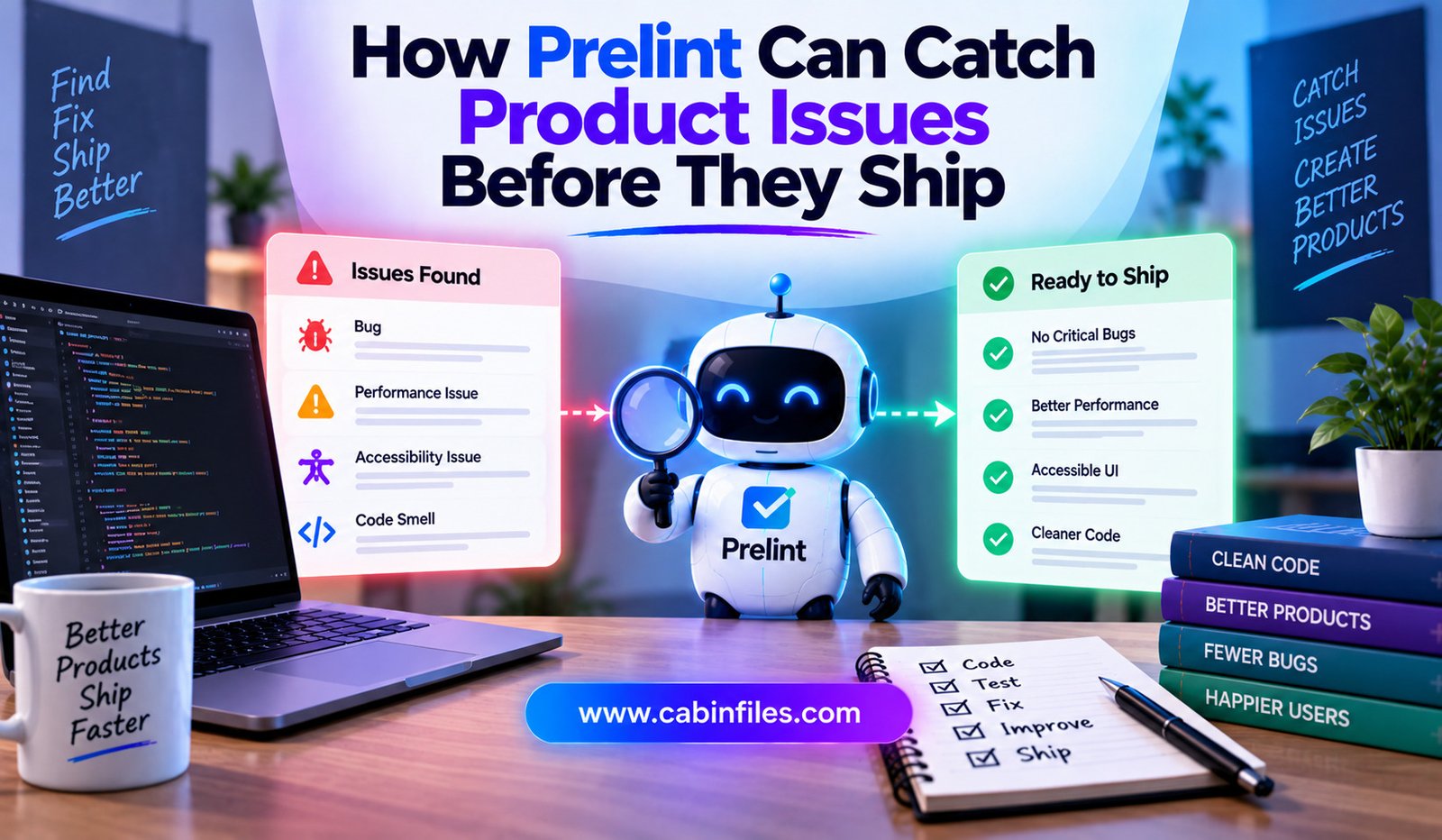
Software development has changed dramatically with the rise of AI coding agents. Developers can now ask tools such as coding agents to implement features, modify existing functionality, fix bugs, and create pull requests in a fraction of the time that traditional development might require.
But faster coding creates a new challenge.
A pull request can contain clean, well-structured, tested code and still be wrong for the product.
An AI agent may misunderstand a business rule, overlook an architectural decision, introduce an unplanned feature, or implement behavior that contradicts a requirement written months earlier. Traditional code review tools are often designed to determine whether code works correctly, not whether it matches the product decisions behind it.
Prelint is designed to address this gap. It reviews pull requests against product specifications, architecture decisions, documentation, and other project context to identify product drift, specification violations, business-logic problems, and scope changes before they reach production.
What Is Prelint?
Prelint is an AI-powered product review tool designed to work alongside existing code-review and development tools.
Instead of replacing a linter, type checker, security scanner, or traditional code reviewer, Prelint focuses on a different question:
Does the code match what the team actually decided to build?
Its documentation explains that teams can provide product specifications, architecture decision records, API contracts, compliance rules, and other Markdown-based documentation. Prelint then uses this information as context when reviewing pull requests.
This makes the tool particularly relevant for teams using AI coding agents, where the volume of generated code can make it harder for humans to inspect every product decision manually.
Why Passing Tests Isn’t Always Enough
Automated tests are essential, but they cannot necessarily determine whether a feature follows the intended product requirements.
Imagine a company has a documented rule that invoices must be payable within 30 days. An AI coding agent modifies the billing system and changes the payment period to 60 days.
The resulting code could be syntactically correct.
The tests might even pass if the existing tests do not check the payment period.
But the implementation would still violate an important business decision.
This is the type of product-level problem Prelint is designed to identify. Its review process compares changes against documented specifications and decisions rather than limiting its analysis to conventional code quality.
How Prelint Reviews a Pull Request
Prelint integrates with GitHub and can automatically review pull requests when they are opened, reopened, marked ready for review, or updated with new commits. Developers can also request a review directly.
The process involves several stages.
First, Prelint receives the pull-request event and retrieves the relevant code changes.
It then assembles review context from sources such as organization-level rules, project specifications, repository documentation, and Markdown files. The documentation says this context is prioritized within an 80,000-character budget.
The AI review engine then compares the changes against that context.
Finally, a second AI validation pass checks findings before they are posted. Findings that are speculative, unsupported by the diff, contradictory to documented context, or primarily related to ordinary linter territory can be filtered out.
This multi-stage approach is intended to reduce unnecessary warnings while keeping the review focused on meaningful product issues.
Catching Product Drift
One of the most important concepts behind Prelint is product drift.
Product drift happens when implementation gradually moves away from the decisions or requirements that originally defined a feature.
This can happen even when every individual code change appears reasonable.
For example, a product requirement might specify that customers receive a notification whenever an order changes. An AI-generated change could update the order successfully but accidentally remove the notification step.
The code may still compile and pass unrelated tests.
Prelint can compare the implementation against the documented rule and flag the mismatch before the change is merged. Its published examples specifically describe checking business workflows and architecture rules against pull-request changes.
Detecting Business-Logic Problems
Business logic is another area where traditional technical checks can have limitations.
A type checker can determine whether a value has the correct type. A linter can identify certain code-quality problems. A security scanner can detect known security risks.
But none of these tools necessarily understand why a company chose a particular business rule.
Prelint attempts to provide that missing context.
Its review process evaluates whether calculations, workflows, and data transformations match documented requirements. This can be useful for systems involving pricing, payments, subscriptions, permissions, eligibility rules, order processing, or other business-critical behavior.
The benefit is especially relevant when small changes can have significant commercial consequences.
Finding Scope Drift
AI coding agents can sometimes modify more than the original task requires.
A developer may ask an agent to fix a checkout problem, but the resulting pull request might also change unrelated validation logic, introduce a new dependency, or modify another part of the product.
These changes may not necessarily be bugs.
However, they can increase risk because the pull request is now doing more than the team intended.
Prelint includes scope drift among the areas it evaluates. It can assess whether a pull request introduces changes outside its stated purpose or includes unrelated modifications.
This can help teams keep AI-generated changes focused.
Using Existing Product Documentation
Prelint becomes more useful when a development team maintains clear documentation.
Teams can store product specifications, architecture decisions, and other relevant information as Markdown files in their repositories. Prelint indexes these files automatically and uses them as review context.
This creates an interesting relationship between documentation and automated code review.
Instead of documentation being something developers read only when they need it, documented decisions can become active rules that influence future pull-request reviews.
For example, an architecture decision record might state that a particular event-processing pattern must be used. If a later pull request introduces a different implementation, Prelint can use the documented decision as part of its review.
AI Agents Can Act on Prelint Feedback
Prelint is also designed with AI coding agents in mind.
Its findings appear as standard GitHub review comments pinned to the relevant lines of the diff. According to Prelint’s documentation, an AI coding agent that can read pull-request comments can use those findings to make corrections without requiring a custom integration.
This creates a feedback loop:
AI agent writes code → opens pull request → Prelint reviews it → agent reads feedback → agent fixes the issue → Prelint reviews again.
When a new commit is pushed, Prelint performs another review and automatically resolves findings that no longer apply.
This allows human developers to focus more on reviewing the final result rather than manually correcting every intermediate AI-generated mistake.
Complementing Existing Code-Review Tools
Prelint is not intended to replace conventional development tooling.
Its documentation explicitly distinguishes product review from technical checks such as code style, formatting, type safety, security scanning, and conventional bug detection.
A modern development workflow can therefore use several layers of review.
A linter can check style.
A type checker can check types.
Automated tests can verify expected behavior.
Security tools can search for vulnerabilities.
And Prelint can check whether the implementation aligns with documented product intent.
Together, these layers can provide broader coverage than relying on a single review system.
Keeping Documentation Current Matters
There is an important limitation to this approach: Prelint can only enforce the product knowledge it has access to.
If the documentation is outdated, incomplete, or ambiguous, an automated product review can reach the wrong conclusion.
Prelint’s own guidance recommends keeping specifications current and writing requirements in a clear, machine-readable style. It also recommends documenting important product and architecture decisions.
This means the tool can encourage a useful engineering habit: treating product decisions as living technical context rather than information that disappears into meetings, chats, or old tickets.
Decision Tracking Adds Another Layer
Prelint has also developed a broader decision-recording concept around its reviews.
Its current product describes a system where decisions found in code changes can be recorded with information about who made the decision, when it happened, where it came from, and whether a person or AI made it.
This can become increasingly valuable as AI agents contribute more code.
When an agent makes a product-impacting decision, teams need to know not only what changed but also why that behavior exists.
A record of those decisions can make future maintenance, audits, and product discussions easier.
Security and Code Privacy
Because Prelint needs access to source code and product documentation, security is an important consideration.
Prelint states that repository clones are encrypted at rest and stored on isolated per-tenant volumes. It also says reviews run in dedicated containers that are destroyed after completion and that its LLM calls use zero-retention APIs.
Teams should still review the platform’s current security documentation and determine whether its data-handling practices meet their own organizational and regulatory requirements.
Why Prelint Matters as AI Coding Grows
The faster AI agents become at writing code, the more important product-level verification becomes.
If developers manually write every change, they are often deeply familiar with the reasoning behind what they are implementing.
An AI agent may not have that same institutional context.
It can see the code but not necessarily understand why the company chose one payment rule over another, why a particular architecture decision was made, or why an apparently harmless feature is outside the product’s intended scope.
Prelint attempts to turn that institutional knowledge into something that can actively participate in the development process.
Final Thoughts
Prelint addresses a growing problem in AI-assisted software development: code can be technically correct while still being the wrong product decision.
By reviewing pull requests against product specifications, architecture decisions, business rules, and repository documentation, Prelint adds a product-alignment layer to the traditional development review process.
Its ability to return inline feedback also creates a practical workflow for AI coding agents. An agent can receive the review, make corrections, push another commit, and trigger another review before a human makes the final decision.
As software teams increasingly rely on AI agents to produce code at high speed, tools that verify **what should be built—not just whether the code runs—**could become an important part of modern software development.
Prelint’s approach is essentially about adding one more question to every pull request:
Does this code actually build the product we agreed to build?