
Turning a software idea into a working application has traditionally required several stages. Someone has to define the product, design the interface, create the database, write frontend and backend code, configure authentication, connect payments, test the application, and finally deploy it.
For non-developers and small teams, this process can become expensive and time-consuming.
AI app builders are changing that workflow by allowing people to describe what they want in natural language and let AI handle much of the technical implementation. OverSkill takes this concept further by focusing on building complete, usable applications rather than simply generating an initial interface.
The platform allows users to describe an application in plain English and uses AI to create its screens, database, authentication, payments, integrations, and deployment.
What Is OverSkill?
OverSkill is an AI-powered application builder designed to turn product ideas into working applications without requiring users to write the code themselves.
Instead of beginning with a blank development environment, users describe what they want to build. OverSkill then interprets the request and creates the application structure.
The platform is aimed at people such as business operators, agencies, consultants, creators, and small-business owners who may have useful software ideas but do not necessarily have a development team available to build them.
This makes the platform interesting not only for developers but also for people who understand a business problem better than they understand programming.
From a Sentence to an Application
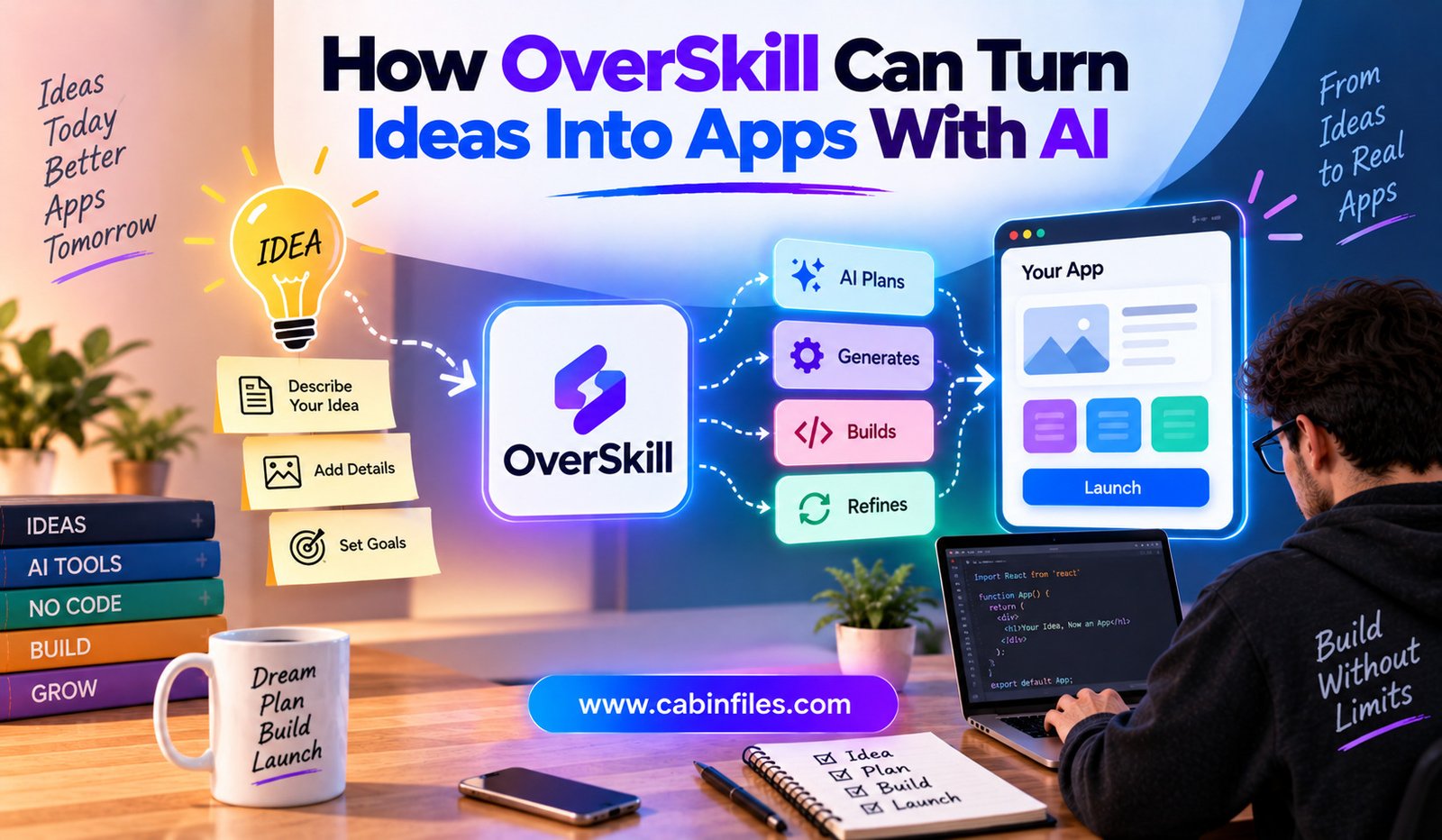
The basic OverSkill workflow is designed around three stages: describe, generate, and ship.
First, the user explains the idea in plain language. For example, someone could describe a booking application for a salon or a CRM for an agency.
OverSkill can then ask questions and propose a structure before generating the application. Users can refine the idea before the build begins.
The second stage is generation. The platform creates elements such as database tables, pages, authentication, payments, and integrations.
Finally, the application can be deployed and accessed through a live domain.
This approach removes many of the technical steps that normally stand between an idea and a usable prototype.
Building More Than a Frontend
One important difference in OverSkill’s approach is its focus on the operational parts of an application.
A typical AI website generator may produce an attractive interface but leave users responsible for connecting databases, authentication, payment processing, hosting, and other services.
OverSkill positions itself around a fuller application stack. Its current platform includes sign-in, databases, payments, email, push notifications, mobile installation, scheduling, and integrations.
That means a user can describe not just how an application should look but also what it needs to do.
For example, a booking application could require customer accounts, appointment records, payment processing, reminders, and an administrative dashboard.
Instead of treating those as completely separate development projects, OverSkill attempts to connect them during the initial build.
Authentication Built Into the App
User accounts are a fundamental part of many modern applications.
Building a secure authentication system manually can involve database design, password handling, session management, social login, account recovery, and security considerations.
OverSkill provides built-in sign-in capabilities, including Google, Apple, and email authentication according to its current product information.
This can make it easier for someone creating an application to add user accounts without implementing the entire authentication infrastructure from scratch.
For business applications, this can be particularly useful when different customers need their own accounts and personalized information.
Databases Without Starting From Scratch
Most useful applications need somewhere to store information.
A CRM needs contacts and deals. A booking application needs appointments. An e-commerce application needs products and orders. A client portal needs customer information and documents.
OverSkill can generate database structures from what the user describes. The platform says users own their data and can export it when needed.
This is important because an AI-generated application is much more useful when it can store and retrieve real information rather than functioning as a static demonstration.
The database becomes part of the application architecture instead of an additional system that needs to be configured separately.
Payments Can Be Part of the Product
For businesses, creating an application is often connected to a commercial goal.
An application might sell subscriptions, accept bookings, process orders, or charge customers for premium features.
OverSkill includes built-in payment capabilities and currently advertises payments across 195 countries.
This means entrepreneurs can think about monetization while describing the application rather than treating payments as a later development project.
Of course, businesses still need to consider payment-provider requirements, taxes, refunds, compliance, and other commercial responsibilities.
Mobile Access Without a Separate App Project
Another notable feature is mobile support.
OverSkill says applications can run on iPhone and Android and can be installed with a home-screen experience without requiring a traditional App Store review process.
This can be useful for businesses that need customers or employees to access an application from smartphones.
For example, a field-service company could build an internal scheduling system that employees access while working away from a desktop computer.
Instead of maintaining completely separate web and mobile development projects, a business can start with an application that works across devices.
Integrations Connect Apps to Existing Tools
Modern applications rarely operate in isolation.
A business may already use payment platforms, email services, spreadsheets, analytics tools, communication systems, or AI providers.
OverSkill currently advertises more than 100 integrations, including services such as Stripe, GitHub, Slack, OpenAI, and Anthropic.
These integrations can expand what an AI-generated application is capable of doing.
For instance, an internal application could connect to existing business data, send notifications through a communication service, or use an AI model to provide intelligent features.
This reduces the need to manually connect every external service from scratch.
AI Can Help Improve the Original Idea
One challenge with AI app building is that users may know what problem they want to solve without knowing exactly how the application should be structured.
OverSkill includes an AI prompt builder that can help expand an initial idea. Its interface asks about areas such as target customers, pain points, goals, business model, and revenue model.
This can be valuable during the planning stage.
Instead of simply typing, “Build me a fitness app,” a user can develop the idea into something more specific, such as a fitness platform for beginners with workout tracking, user accounts, progress dashboards, and subscription features.
Better input can give the AI more useful information for generating the product.
Templates Can Speed Up Development
Starting from a completely blank project is not always necessary.
OverSkill provides templates covering different categories and use cases. Its current template library includes areas such as business, e-commerce, productivity, education, finance, health, entertainment, and social applications.
Templates can provide a starting structure that users then modify through natural-language instructions.
This can be especially useful for common business applications.
For example, someone building a lead-generation funnel may not need to describe every screen and interaction from scratch. They can start from an existing template and tell the AI what should be changed.
Building AI-Powered Applications
OverSkill is not limited to applications that merely use conventional forms and databases.
The platform explicitly includes AI agents among the types of products users can build.
This opens up another layer of possibilities.
A user could build a chatbot, an automated workflow, an AI-powered customer-support tool, or another application where artificial intelligence is part of the product itself.
OverSkill also provides integrations with AI services, allowing applications to connect with providers such as OpenAI and Anthropic.
The distinction is important: AI can be used not only to build the application, but also to power features inside the application.
Working With AI Coding Agents
OverSkill also provides support for external AI agents.
Its help center currently includes documentation for using OverSkill from AI agents such as Claude, Cursor, and Codex.
This is significant because AI-assisted development is increasingly moving toward agent-based workflows.
Instead of a human manually performing every change, an AI agent can potentially interact with the application-building environment, make changes, and help iterate on a project.
This creates a workflow where the user provides the product direction while AI handles more of the implementation work.
Why This Matters for Entrepreneurs
One of the biggest advantages of AI app builders is reducing the gap between having an idea and testing it in the real world.
Previously, someone with a software idea might need to find a technical co-founder, hire freelancers, or spend months learning development before launching a prototype.
With an AI application builder, the first version can potentially be created much faster.
That does not mean every idea will automatically become a successful business.
Market research, customer feedback, pricing, usability, security, and product strategy still matter.
But reducing the cost and time required to build the first version can make experimentation easier.
Developers Can Also Benefit
Although OverSkill is strongly positioned toward non-developers, developers can also benefit from this type of platform.
Experienced developers often spend time building repetitive infrastructure before reaching the unique part of a product.
Having AI handle parts of authentication, database setup, deployment, integrations, or basic UI construction can allow developers to concentrate on functionality that requires deeper engineering decisions.
The ability to export application code and database information also gives developers greater flexibility when they need to take the project into a more conventional development environment.
What Users Should Keep in Mind
AI-generated software still needs human oversight.
A natural-language description can be misunderstood. An automatically generated database may not perfectly match future requirements. Business logic can contain unexpected edge cases, and security-sensitive applications require careful review.
Users should test important workflows, verify permissions, inspect data handling, and validate integrations before relying on an application for critical business operations.
The quality of the final product also depends heavily on how clearly the user communicates the desired outcome.
OverSkill’s own documentation acknowledges that vague instructions can produce vague results and recommends being specific about what should be built.
Final Thoughts
OverSkill represents the growing shift toward idea-to-app development with AI.
Instead of requiring users to understand every technical step, the platform allows them to describe an outcome in natural language and have AI generate much of the underlying application.
Its current feature set covers databases, authentication, payments, email, notifications, mobile access, scheduling, integrations, templates, and AI-powered applications.
The biggest opportunity is not simply faster coding. It is making software experimentation accessible to people who understand a problem but may not have the technical resources to build a solution from scratch.
As AI becomes better at handling complex application requirements, platforms such as OverSkill could make the process of turning an idea into a working digital product increasingly accessible.
The developer of the future may not always begin with code. Increasingly, they may begin with a description of the problem, the customer, and the desired outcome—and let AI turn that idea into the first working version.