
Software development has always depended on tools that help developers write, test, debug, and maintain code. For decades, the basic workflow remained relatively consistent: developers understood a requirement, designed a solution, wrote code, tested it, reviewed the changes, and deployed the finished application.
AI coding agents are beginning to change that process.
Unlike traditional coding assistants that mainly suggest lines or snippets of code, AI coding agents can work on broader development tasks. They can inspect repositories, modify multiple files, run commands, execute tests, investigate errors, and sometimes create complete pull requests.
This does not mean traditional development is disappearing. Instead, teams are entering a period where human developers and AI agents can share more of the implementation work.
Understanding the difference between AI coding agents vs traditional development workflows can help businesses and developers decide where AI provides genuine value and where conventional engineering practices remain essential.
What Is a Traditional Development Workflow?
A traditional software-development workflow usually begins with a requirement or problem.
A developer studies the requirement, discusses technical details with the team, designs an approach, and then writes the necessary code. Once the implementation is complete, the developer runs tests and checks the result.
The changes are then reviewed by another developer or team member. After approval, the code can be merged and eventually deployed.
The important characteristic is that the human developer performs most of the reasoning and implementation.
Tools can automate individual parts of the process, but the developer generally controls the sequence.
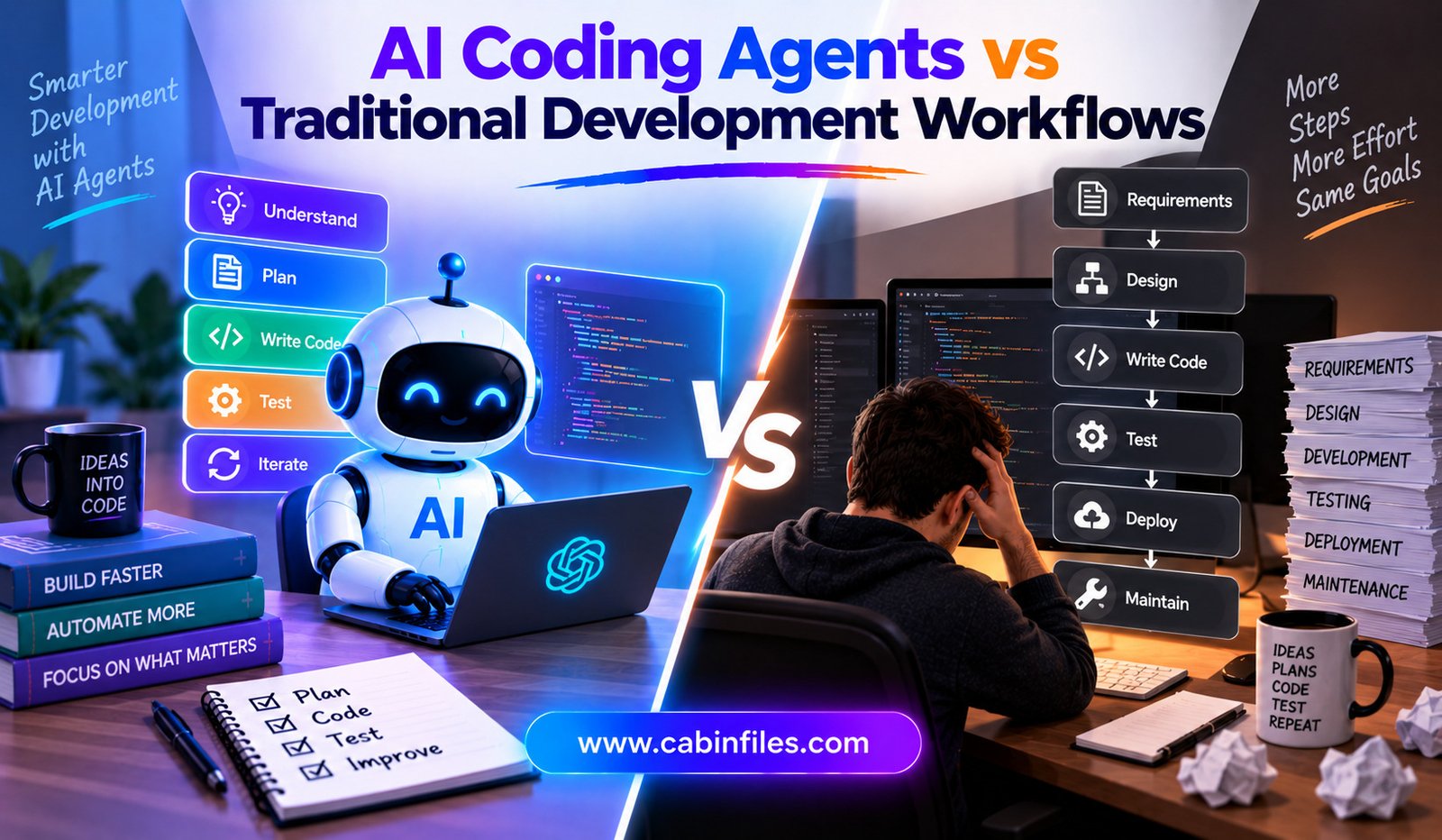
For example, a typical workflow might look like:
Requirement → planning → coding → testing → code review → deployment
This approach has worked extremely well for decades and remains the foundation of professional software engineering.
What Are AI Coding Agents?
AI coding agents take a more autonomous approach.
Instead of simply suggesting code, an agent can receive a development objective and determine several steps needed to accomplish it.
For example, a developer could ask an agent to investigate why a particular API endpoint is failing. The agent might inspect the relevant files, search for related functions, identify a likely problem, modify the code, run tests, and report its findings.
Modern agentic development tools can interact with repositories and development environments rather than operating only inside a chat window.
The workflow can therefore become:
Requirement → AI agent investigates → implementation → tests → review → human approval
The developer still defines the objective and evaluates the final result, but the agent can perform more of the intermediate work.
The Biggest Difference: Who Performs the Implementation?
The clearest difference between the two approaches is the role of the developer.
In a traditional workflow, developers are responsible for writing most of the implementation.
With an AI coding agent, developers can delegate portions of that work.
This does not necessarily make the developer less important.
Instead, the role can shift toward defining requirements, reviewing architecture, validating AI-generated changes, testing edge cases, and making higher-level technical decisions.
In other words, AI agents can reduce the amount of manual coding while increasing the importance of effective supervision.
Speed of Development
One of the strongest arguments for AI coding agents is development speed.
A developer may spend significant time searching through a large codebase, locating related functions, writing repetitive code, and creating standard tests.
An AI agent can potentially perform several of these tasks quickly.
For repetitive or well-defined work, the productivity improvement can be significant.
For example, an agent could create similar API handlers, update references across multiple files, generate test cases, or migrate repetitive code patterns.
Traditional development can still be faster for certain tasks, particularly when the developer already understands the code extremely well and the change is small.
Therefore, AI does not automatically make every development task faster. Its biggest advantages often appear when the task involves exploration, repetitive implementation, or multiple connected files.
Understanding the Codebase
Developers working traditionally need to understand enough of a project to make safe changes.
They may manually search files, inspect dependencies, read documentation, and trace how different components interact.
AI coding agents can automate some of this exploration.
An agent can search through a repository, identify related files, inspect functions, and use the resulting information to plan a modification.
This can be particularly useful in older or unfamiliar codebases.
However, repository exploration is not the same as genuine understanding.
An AI agent can misunderstand an architectural decision or overlook an important business rule. Human developers therefore still need to provide context and verify important conclusions.
Coding and Repetitive Work
Traditional coding is effective but can consume substantial developer time when the task is repetitive.
Examples include creating similar components, updating boilerplate, writing straightforward tests, renaming APIs, converting data structures, or making consistent changes across many files.
AI agents can be particularly useful for these tasks.
A developer can describe the desired change and allow the agent to implement the repetitive portions.
This creates an important productivity advantage: developers can spend less time typing predictable code and more time solving problems that require engineering judgment.
Testing and Verification
Testing is important in both workflows.
In traditional development, developers write or update tests and execute them using established tools.
AI coding agents can also run tests and respond to failures.
For example, an agent may make a change, execute the project’s test suite, identify an error, modify the implementation, and run the tests again.
This creates an iterative development loop.
However, passing automated tests does not prove that the implementation is correct.
Tests only verify behaviors that have been encoded into the test suite. An AI agent could satisfy existing tests while implementing the wrong business behavior.
Human review therefore remains necessary.
Code Review Changes With AI Agents
Traditional code review is generally performed by one or more developers examining a pull request.
They evaluate the implementation, look for bugs, consider maintainability, and determine whether the change meets requirements.
With AI-generated code, the review process becomes even more important.
An AI agent can produce a large amount of code quickly, which means developers may need to review more generated changes than they would normally write themselves.
This creates a potential paradox:
AI can make coding faster while making careful review more important.
Teams should avoid treating AI-generated code as automatically trustworthy simply because it was produced by a sophisticated model.
Handling Business Requirements
This is an area where traditional development can have an important advantage.
Experienced developers often carry knowledge about a product’s business rules, customer expectations, technical history, and architectural decisions.
AI agents may not automatically know all of this information.
For example, a company might have a rule that a particular customer category cannot receive a certain discount. An AI agent could implement a seemingly reasonable discount system without realizing that this exception exists.
Giving agents access to current product documentation, architecture decisions, tests, and repository context can reduce these problems.
But humans remain responsible for determining whether the software actually solves the intended business problem.
Cost Considerations
AI coding agents introduce a different cost structure.
Traditional development primarily costs developer time and infrastructure.
AI-assisted development adds model usage, which may be measured through tokens, requests, subscriptions, or other pricing systems.
For simple tasks, AI usage can be inexpensive.
For large repositories and complex agent sessions, costs can increase because the agent may process substantial amounts of code and repeatedly interact with the model.
Teams therefore need to evaluate both sides of the equation:
How much developer time does the AI save compared with the cost of running the agent?
For many organizations, the answer may still favor AI, particularly when agents handle repetitive engineering work.
Security and Permissions
AI agents can have considerably more access than ordinary chat-based assistants.
Depending on the development environment, an agent may read source files, modify code, execute shell commands, access development services, or interact with external tools.
That creates security considerations.
Traditional development workflows also involve security risks, but the developer typically controls each command directly.
With autonomous agents, organizations should carefully define permissions and avoid granting unnecessary access to production systems, secrets, sensitive files, or critical infrastructure.
The principle should be simple:
Give an AI agent only the access it actually needs.
Creativity and Problem Solving
AI coding agents are increasingly capable of generating alternative solutions and suggesting implementation strategies.
This can help developers explore approaches they might not immediately consider.
However, human developers remain important for product strategy and architectural judgment.
An AI can propose three technically valid approaches, but deciding which one best fits the company’s long-term goals requires broader context.
Traditional development places that responsibility directly on engineers.
AI-assisted development allows the AI to participate in the exploration while humans retain decision-making authority.
When Traditional Development May Be Better
AI coding agents are not the ideal solution for every task.
Traditional development may be preferable when a project involves highly sensitive systems, unusual architecture, strict regulatory requirements, or complex requirements that have not been clearly documented.
It can also be more efficient for a highly experienced developer making a small change that they can implement and test immediately.
Teams should therefore avoid adopting AI simply because it is fashionable.
The right question is whether the technology improves the particular workflow.
When AI Coding Agents Make More Sense
AI agents can provide strong value for tasks such as:
- Repetitive implementation
- Repository exploration
- Bug investigation
- Test generation
- Documentation updates
- Refactoring
- Code migrations
- Prototyping
- Routine pull requests
- Explaining unfamiliar code
They can be particularly useful when developers need to move quickly but still want the changes to remain inside established Git, testing, and review processes.
The Future Is Likely to Be Hybrid
The debate between AI coding agents and traditional development does not necessarily have to end with one replacing the other.
A more realistic future is a hybrid workflow.
Developers define goals and constraints. AI agents investigate problems and implement routine changes. Automated systems run tests and security checks. Human engineers review important decisions and approve production changes.
This creates a layered process where each part of the system performs the work it is best suited for.
The developer becomes less of a manual code producer and more of an engineer responsible for directing, evaluating, and improving the overall system.
Final Thoughts
The comparison between AI coding agents vs traditional development workflows is ultimately not about choosing between humans and machines.
Traditional development provides proven processes for planning, coding, testing, reviewing, and maintaining software. AI coding agents introduce greater automation into those processes by allowing software tools to perform larger portions of implementation and investigation.
The biggest advantage of AI agents is their ability to handle multi-step development tasks quickly. The biggest challenge is ensuring that their speed does not come at the expense of correctness, security, maintainability, or product intent.
For modern development teams, the strongest approach may be to combine both models.
Let AI handle repetitive and well-defined work, while developers remain responsible for architecture, business logic, security, quality, and final decisions.
As AI coding agents continue to improve, software development is likely to become less about manually writing every line of code and more about describing problems clearly, supervising intelligent tools, and ensuring that the final software does exactly what users need.