
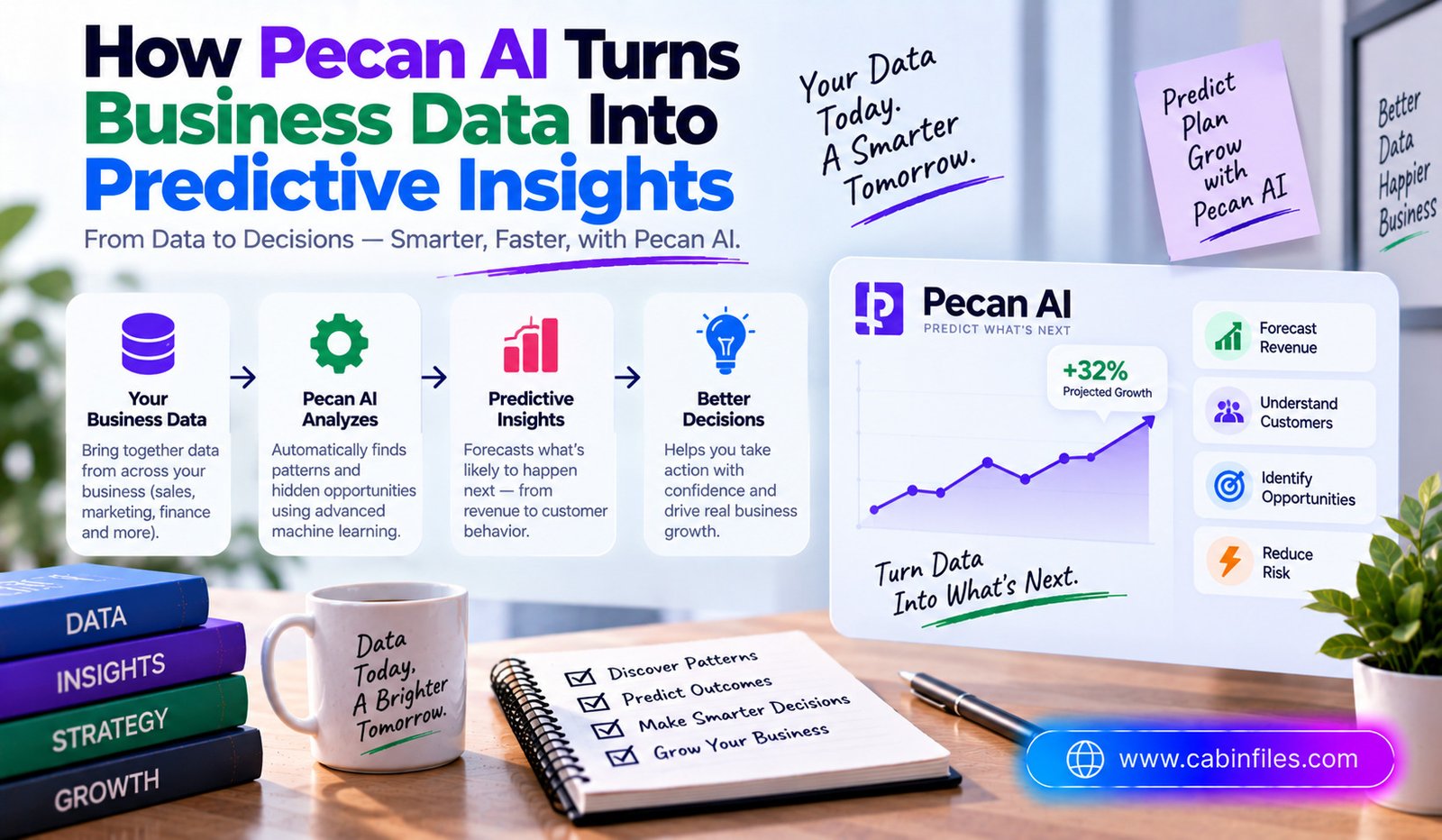
Businesses collect enormous amounts of data every day. Customer transactions, website activity, marketing campaigns, sales interactions, product usage, inventory movements, and support records all contain useful information. The challenge is not always collecting this data. The bigger challenge is understanding what it can tell a business about the future.
Traditional analytics is excellent at explaining what has already happened. Dashboards can show last month’s sales, customer churn, campaign performance, or inventory levels. But businesses often need a different answer: What is likely to happen next?
This is where predictive analytics becomes valuable. Pecan AI is designed to help business and data teams use their existing information to build predictive models without requiring extensive data science expertise. Its platform combines automated machine learning with generative AI to help turn business questions and historical data into predictions that teams can use in their everyday workflows.
What Is Pecan AI?
Pecan AI is a predictive analytics platform built around the idea that businesses should be able to use their data to anticipate future outcomes.
Rather than limiting analytics to reports and historical dashboards, Pecan focuses on predictive questions such as which customers might leave, which leads are likely to convert, how much demand may occur, or which customers could have high lifetime value.
The platform is designed for business and data teams that have useful data but may not have a large data science department. Pecan’s current approach uses a Predictive AI Agent to guide users from a business question through data preparation, model development, validation, and deployment.
This makes predictive modeling more accessible to analysts and other professionals who understand their business but may not want to build machine-learning pipelines entirely from scratch.
From Business Questions to Predictions
One of the most interesting aspects of Pecan is that the process starts with a question rather than simply uploading a dataset and expecting an answer.
For example, a marketing team might want to know which customers are most likely to purchase again. A customer success team could ask which accounts are at risk of churn. An operations department might want to forecast future demand.
Pecan calls this a “predictive question.” A useful predictive question identifies who or what is being analyzed, when the prediction should be made, what behavior or outcome is being predicted, and how far into the future the prediction should look.
This approach is important because good predictive analytics starts with a clearly defined business problem. Even advanced machine-learning technology cannot produce useful results if the question itself is vague.
Connecting Existing Business Data
The next step is getting relevant data into the predictive workflow.
Pecan provides connectors for a range of data warehouses, databases, CRMs, marketing platforms, and other sources. Its website lists integrations including Snowflake, Databricks, Google BigQuery, Amazon Redshift, Salesforce, HubSpot, PostgreSQL, MySQL, Oracle, and others.
This matters because many businesses already have valuable data stored across different systems. Starting from existing infrastructure can reduce the need to create an entirely separate analytics environment.
Pecan’s platform also handles data preparation as part of the modeling process. According to Pecan, its AI agent can generate SQL and transform raw data into training datasets suitable for predictive modeling.
Turning Raw Data Into Model-Ready Information
Raw business data is rarely ready for machine learning immediately.
A customer database, for example, may contain purchase dates, transaction amounts, subscription information, engagement activity, geographic information, and product details. These individual fields may not directly provide the strongest signals for a prediction.
This is where feature engineering becomes important.
Pecan’s automated pipeline analyzes different types of variables and creates features that can help predictive models identify useful patterns. Its documentation describes techniques for numerical, categorical, and date-based information, along with methods for feature selection and measuring feature importance.
The benefit is that teams do not have to manually perform every technical step before experimenting with a predictive model.
Automated Machine Learning Behind the Scenes
Once the data has been prepared, the platform can build and evaluate predictive models.
Pecan’s current documentation says its automated modeling pipeline uses gradient-boosted decision trees, including LightGBM and CatBoost, for its models. It also evaluates different configurations and uses optimization techniques to search for strong model settings for a particular predictive question.
The important point for business users is not necessarily which algorithm is being used. It is that much of the technical model-building process can happen automatically.
Instead of spending weeks manually testing different approaches, teams can concentrate more on defining the business problem, reviewing results, and deciding what actions should follow from the predictions.
Explainable Predictions Make Insights More Useful
A prediction is only valuable if people can understand how to use it.
Imagine a sales team receives a list of leads ranked by their likelihood of converting. If the team has no idea why those leads received their scores, it may be difficult to trust or act on the results.
Pecan emphasizes explainability as part of its predictive workflow. Its platform provides explanations around model performance and predictions, helping users understand the factors influencing outcomes.
This can be particularly important when predictive analytics influences customer outreach, marketing budgets, inventory decisions, or other business activities.
Practical Business Use Cases
Pecan AI can be applied to many business problems where historical information can help estimate future outcomes.
Customer Churn
Companies can use predictive models to identify customers who may be at risk of leaving. Instead of treating every customer equally, retention teams can prioritize accounts showing signals associated with future churn.
Customer Lifetime Value
Businesses can estimate which customers are likely to generate greater long-term value. Marketing and customer success teams can then use these insights when deciding where to focus resources.
Lead Scoring
Sales teams can use predictive lead scoring to prioritize prospects with a higher likelihood of conversion. This can help representatives spend more time on opportunities that show stronger signals.
Demand Forecasting
Retailers and other businesses can use historical sales and operational data to estimate future demand. Better forecasts can support inventory planning and reduce the risk of having too much or too little stock.
Marketing Optimization
Predictive analytics can also help marketers understand which campaigns or customers are more likely to generate valuable outcomes. Pecan lists campaign performance, conversion, and return-related use cases among the applications supported by its platform.
Bringing Predictions Into Existing Workflows
Another important part of predictive analytics is what happens after a model is created.
A prediction sitting inside an analytics dashboard may not have much impact if employees rarely check that dashboard.
Pecan is designed to deliver predictions into systems where teams already work. Its platform describes sending prediction results into CRMs, data warehouses, marketing platforms, and business intelligence workflows through integrations or APIs.
This can make predictive analytics more operational.
For example, a churn score could become part of a customer success workflow. A lead score could be available inside a sales system. A demand forecast could support inventory planning.
The prediction becomes useful because it is connected to a decision.
Predictive GenAI Makes Analytics More Accessible
Pecan has also introduced Predictive GenAI, which combines generative AI capabilities with predictive machine learning.
The goal is not to replace predictive models with a general-purpose chatbot. Instead, generative AI can help business users describe what they want to predict, clarify the modeling task, and generate a starting point for the technical workflow.
Pecan argues that large language models alone are not necessarily the best solution for many numerical and tabular business prediction problems. Its approach combines language-based interaction with machine-learning methods designed for structured business data.
This combination could make predictive analytics easier for teams that understand their business questions but do not specialize in machine learning.
Why Predictive Insights Matter for Businesses
The real value of predictive analytics is not simply producing a forecast.
It is helping businesses move from reactive decision-making toward proactive action.
A traditional report might tell a retailer that sales declined last month. A predictive model can potentially help estimate future demand.
A standard CRM report might show which customers have reduced their activity. A churn model can help identify which accounts could be at greater risk.
A marketing dashboard can show which campaigns performed well. Predictive analytics can help estimate which customers or campaigns may produce stronger future results.
That difference can change how organizations allocate time, money, and resources.
Pecan AI and the Future of Business Analytics
As businesses accumulate more data, the demand for actionable insights will continue to grow.
However, simply having more dashboards does not necessarily create better decisions. Companies need tools that can help connect historical information with future possibilities.
Pecan AI represents one approach to this challenge by combining automated predictive modeling, data preparation, machine learning, explainability, and generative AI assistance.
Its focus on business questions also reflects a broader change in analytics. Instead of making advanced technology the starting point, businesses can begin with a practical question and use AI to help find an appropriate predictive solution.
Final Thoughts
Pecan AI shows how business data can become more valuable when companies use it to understand what may happen next, rather than only reviewing what has already happened.
By connecting existing data sources, preparing information for modeling, automating feature engineering and model development, evaluating predictions, and delivering results into existing workflows, Pecan aims to make predictive analytics more accessible to business teams.
Its Predictive GenAI approach adds another layer by allowing users to interact with predictive modeling through natural-language guidance while retaining machine-learning techniques suited to structured business data.
For companies looking to make better decisions from customer, sales, marketing, operational, or financial data, predictive analytics can provide a valuable bridge between historical information and future planning.
The biggest opportunity is not simply knowing more about your data. It is using that data to make smarter decisions before the outcome happens.