
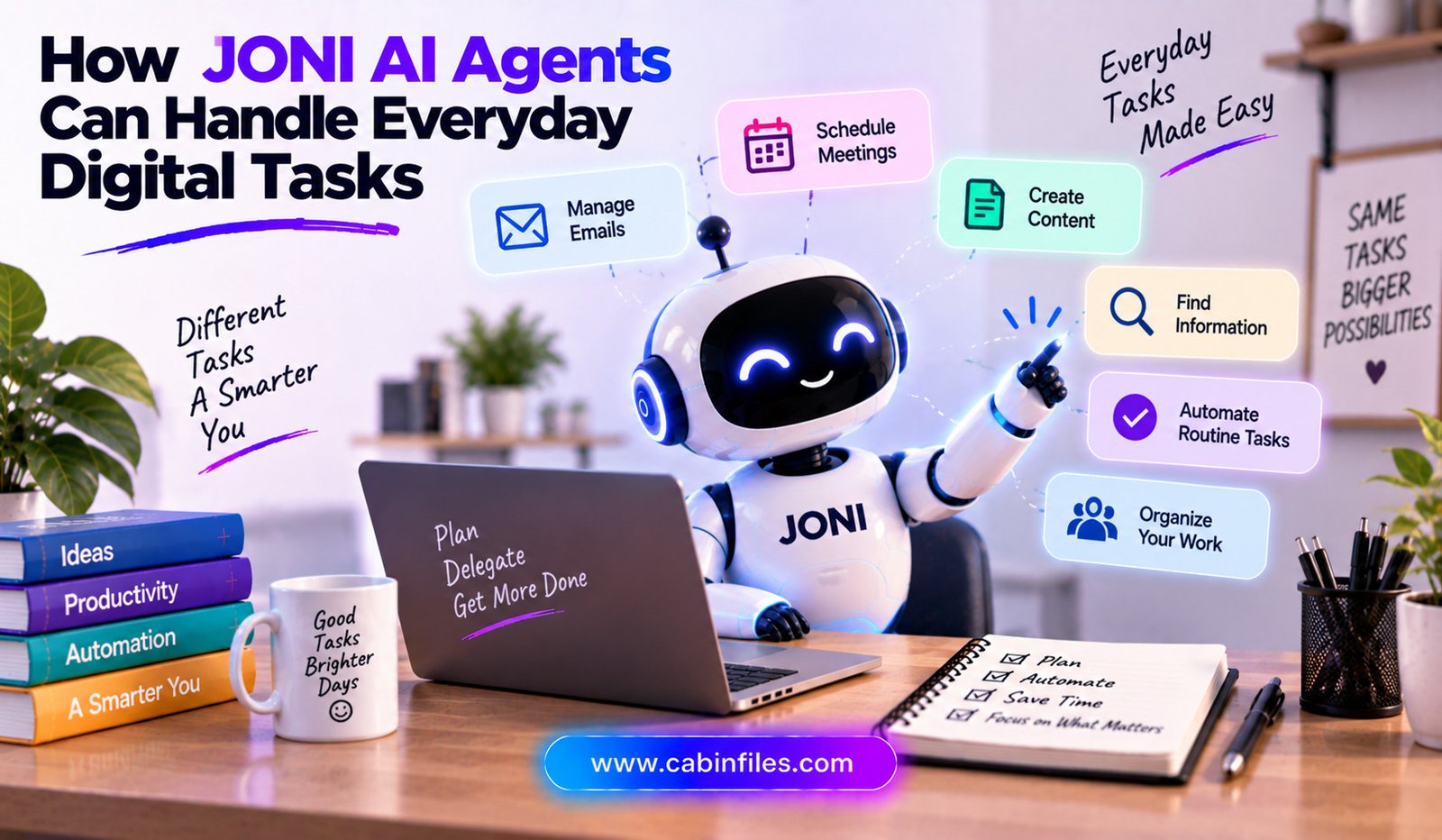
Artificial intelligence has changed the way people work, communicate, research information, and manage their daily responsibilities. However, using AI does not always mean less work. In many cases, people still have to open several applications, move information between tools, repeat instructions, and manually complete the final steps.
JONI takes a different approach by combining AI models with specialized agents that can perform tasks on a user’s behalf. Instead of treating AI as something that simply answers questions, JONI presents it as a personal AI computer designed to help complete work.
This makes JONI particularly interesting for everyday digital tasks that involve multiple steps. From managing emails and researching information to planning projects and handling online tasks, AI agents can potentially reduce the amount of repetitive work people need to perform themselves.
What Are JONI AI Agents?
JONI is designed around a team of specialized AI agents rather than a single assistant trying to handle every task. JONI acts as an orchestrator, coordinating agents that can perform different types of work inside a user’s workspace. Its current terms describe agents that can send and receive email, browse websites, analyze data, complete forms, place calls, and interact with third-party services.
The benefit of this approach is specialization.
Instead of asking one AI system to perform every part of a complicated task, different agents can contribute according to their capabilities. JONI’s platform is designed to select the appropriate model and coordinate the work behind the scenes.
For users, the experience can remain simple: describe what needs to be done and allow the AI system to organize the necessary steps.
Managing Email Without Constantly Checking Your Inbox
Email is one of the most repetitive parts of modern digital work. Important messages can become buried under newsletters, notifications, requests, and routine conversations.
JONI provides its own agent email address and describes a full email system that can read, sort, and reply to messages. Users can forward information to their JONI address, allowing the system to handle parts of the email conversation and involve the user when something requires attention.
This could be useful for routine communication.
For example, someone could use an AI agent to organize incoming information, handle straightforward correspondence, or summarize conversations before the user reviews them.
The main advantage is not simply writing faster emails. It is reducing the number of small email decisions a person has to make throughout the day.
Researching Information Online
Research can take much longer than expected because finding information is only the first step. Users often need to open multiple websites, compare sources, organize findings, and turn scattered information into something useful.
JONI’s agents can browse websites and perform research-oriented tasks. Its platform highlights market research as one example, describing a workflow where specialized agents can find, verify, and distill information.
This could help with tasks such as researching competitors, exploring a market, gathering background information, or preparing an initial research summary.
Human review is still important, especially when decisions depend on accuracy. AI-generated research should be checked against reliable sources before it is used for important business, financial, or legal decisions.
Helping With Planning and To-Do Lists
Planning sounds simple until a task involves several dependencies.
For example, planning a small online project might require researching options, creating a checklist, contacting people, comparing prices, and organizing deadlines.
JONI specifically lists research, planning, and to-dos among the everyday tasks its system can handle.
Instead of using AI only to suggest what you should do, an agent-based system can help organize the individual steps involved in getting the task completed.
This can be especially useful for people who manage several small projects simultaneously and want to spend less time coordinating routine work.
Handling Online Forms and Web Tasks
Many digital responsibilities involve websites rather than traditional applications.
People regularly fill out forms, navigate websites, collect information, and complete repetitive online processes. JONI’s terms state that its agents can browse websites, complete forms, and interact with third-party services.
That creates opportunities for automating parts of online workflows.
For example, an agent might navigate a website, locate relevant information, or complete a form based on instructions provided by the user.
Because online actions can sometimes have real consequences, users should understand what an agent is authorized to do before allowing it to operate independently.
Making and Receiving Phone Calls
Phone calls remain an everyday responsibility for many people, but they can be inconvenient when they involve waiting, scheduling, or following up on routine matters.
JONI provides a dedicated phone line and says its agents can make and receive calls on behalf of users. The company gives examples such as booking appointments, following up on deliveries, and answering calls when the user is unavailable. JONI also says users receive a summary of calls.
This extends AI assistance beyond a chat window.
Instead of simply generating a script for a phone call, an agent can potentially participate in the conversation itself, making the technology more useful for certain routine tasks.
Managing Approved Purchases
Another capability that makes JONI different from a basic chatbot is its ability to handle certain approved purchases.
According to JONI, users can authorize purchases such as domains, subscriptions, and services, while each purchase requires user sign-off and generates a record.
This can be useful when a task requires purchasing something as part of a larger workflow.
For example, launching an online project may require purchasing a domain or subscribing to a service. Instead of stopping the workflow and handling every transaction manually, JONI can assist with the process while keeping approval with the user.
Creating Websites and Digital Projects
JONI’s capabilities extend beyond small administrative tasks.
Its website describes workflows for designing, building, and launching websites, as well as creating media and writing and shipping code.
This demonstrates how agent-based AI can be applied to larger projects.
A website project, for instance, may require research, writing, design, coding, testing, and deployment. Each stage can involve different skills, which makes a multi-agent approach potentially useful.
Rather than treating each stage as a completely separate AI conversation, JONI is designed to coordinate specialized agents around a broader objective.
Remembering Context Across Tasks
One frustration with many AI tools is having to repeat information.
JONI includes a persistent memory system that stores long-term facts and dated working notes. According to its privacy policy, this memory is intended to provide continuity and personalization across sessions.
For everyday work, continuity can be valuable.
If you are working on the same project over several days or weeks, remembering previous decisions and preferences can reduce repetitive explanations.
This makes the assistant more suitable for ongoing workflows rather than isolated questions.
Using Different AI Models for Different Jobs
Another important part of JONI’s approach is model selection.
JONI says it connects multiple leading AI models and automatically chooses the appropriate model for each task.
This means users do not necessarily have to decide which AI model is best every time they start a new task.
One task may benefit from strong reasoning, another from coding capabilities, and another from creative generation. JONI’s model-routing approach is intended to handle that selection as part of the overall workflow.
Why This Matters for Everyday Productivity
The real value of AI agents is not simply producing answers faster. It is reducing the number of manual steps between an instruction and a finished result.
A regular chatbot might tell you how to complete a task. An AI agent can potentially perform some of those steps for you.
That distinction can become significant when a person has dozens of small digital responsibilities every week.
Email management, research, planning, web tasks, phone calls, content creation, and project coordination may individually seem minor. Together, however, they can consume a substantial amount of time.
JONI’s agent-based model aims to bring these activities into one AI environment.
Final Thoughts
JONI AI agents represent a shift from conversational AI toward more action-oriented digital assistance. Instead of only answering questions, JONI is designed to coordinate specialized agents that can research, communicate, browse websites, complete forms, manage email, make phone calls, and assist with larger digital projects.
The biggest advantage is convenience. Users can describe an objective rather than manually coordinating every individual step.
At the same time, autonomous AI should not be treated as completely error-free. Important communications, purchases, research findings, and other consequential actions should receive appropriate human oversight.
As AI agents become more capable, the future of digital productivity may involve fewer separate tools and more systems that can coordinate entire workflows. JONI’s approach provides one example of how that transition could work in everyday life.