
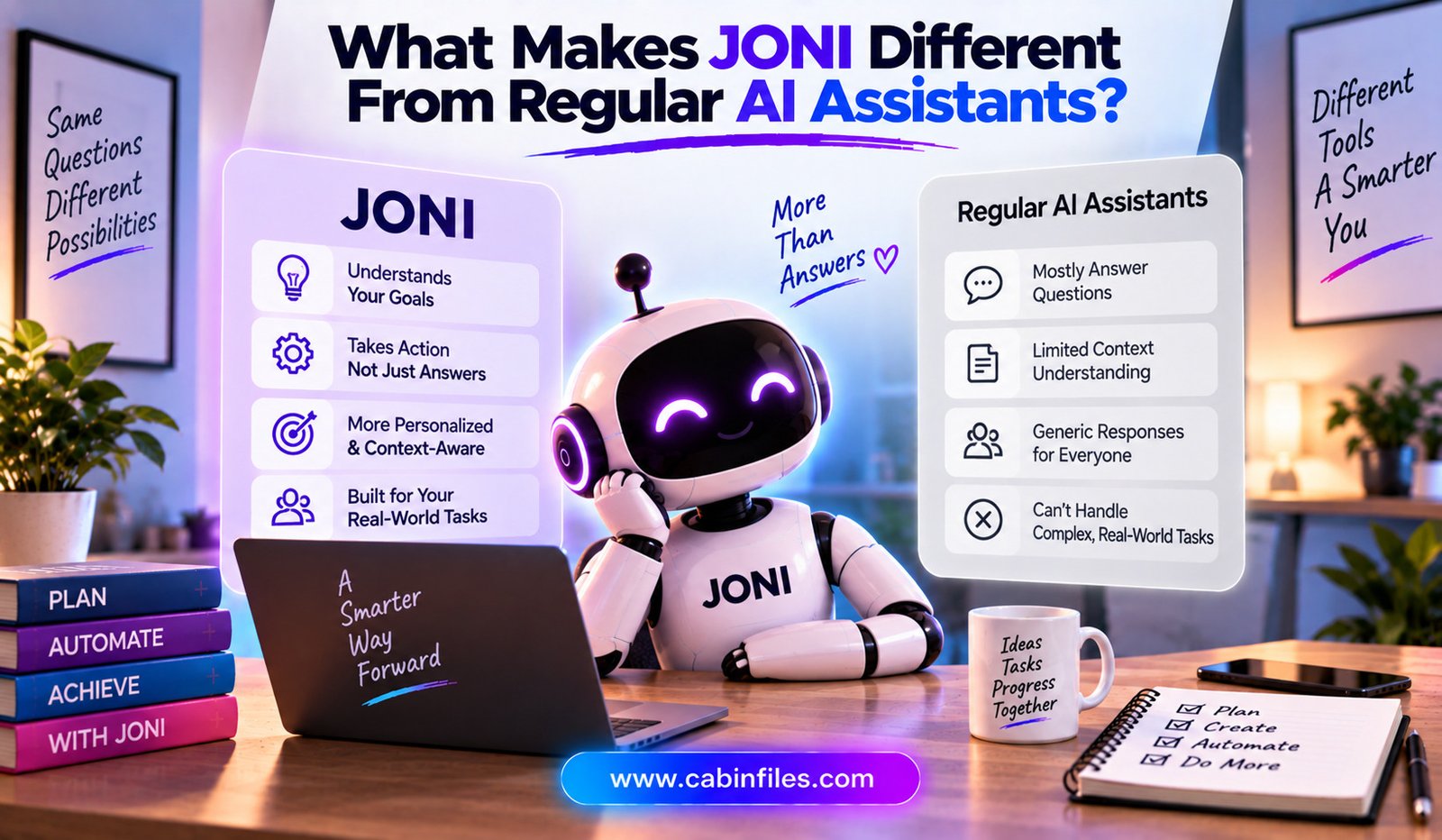
AI assistants have quickly become part of everyday digital work. People use them to write emails, answer questions, summarize documents, generate ideas, create content, and even write code. However, most traditional AI assistants still operate around a relatively simple interaction: you ask a question, receive an answer, and decide what to do next.
JONI takes a different approach.
Positioned as a personal AI computer, JONI is designed to move beyond conversation and coordinate specialized AI agents that can work on larger, multi-step tasks. Instead of requiring users to manage several AI tools individually, JONI aims to bring models, agents, memory, and real-world actions into one environment.
So, what actually makes JONI different from a regular AI assistant?
From Answering Questions to Completing Tasks
The biggest difference is the focus on execution.
A conventional AI chatbot might help you plan a website by generating its structure, suggesting copy, and providing code. You may still need to put those pieces together, find hosting, configure the website, and publish it.
JONI is designed around a more action-oriented workflow. Its platform describes capabilities such as building and launching websites, creating media, writing and shipping code, researching information, and handling everyday tasks.
This changes the role of AI from simply being a source of information to becoming a system that can help carry out work.
The distinction is important because productivity is not always limited by a lack of information. Often, the real problem is having too many steps between an idea and the finished result.
A Team of Specialized AI Agents
Another major difference is JONI’s multi-agent approach.
Rather than expecting one AI model to handle every type of job, JONI coordinates specialized agents. Its official documentation describes agents as specialized AI processes that can perform tasks such as sending email, making calls, browsing websites, and analyzing data.
This is similar to having a digital team where different members have different responsibilities.
One agent could focus on research, another could handle development, while another could work on content or design. JONI acts as the orchestrator that coordinates these capabilities.
For complicated projects, this approach can be useful because large tasks can be broken into smaller jobs instead of forcing one assistant to handle everything in a single conversation.
Access to Multiple AI Models
Regular AI assistants are often closely associated with one primary model or model family. Users may have to decide which AI tool to open depending on the task.
JONI attempts to simplify that process by connecting users with multiple leading AI models and automatically selecting an appropriate model for a particular task. Its official website describes this as choosing the “right brain” for each job.
This can reduce the need to constantly switch between AI applications.
For example, a user might need strong reasoning for one task, creative generation for another, and coding assistance for a third. Instead of manually comparing different AI services, the JONI environment is designed to manage model selection as part of the workflow.
Persistent Memory Changes the Experience
Another feature that separates JONI from a basic chatbot is persistent memory.
Traditional conversations can become disconnected. You may need to repeatedly explain your preferences, project details, or previous decisions when starting a new conversation.
JONI’s service includes a persistent memory system intended to store long-term facts and dated working notes. The company says this is used to improve continuity between sessions.
For people working on ongoing projects, continuity can make AI assistance feel more useful.
Imagine working on a website for several weeks. Instead of explaining the project’s goals and previous decisions every time, a system with persistent memory can use relevant information from earlier work.
That does not mean users should assume the AI will remember everything perfectly. Important information should still be checked, especially when it affects business, financial, or technical decisions.
JONI Can Interact With Real-World Channels
Regular AI assistants generally produce digital responses inside the application where you are chatting.
JONI goes further by providing channels through which agents can perform certain real-world actions. Its website describes an email address, purchasing capability with user approval, and a dedicated phone line. Agents can handle email conversations, make approved purchases, and place or receive calls.
This is a significant shift in how people can think about AI.
Instead of asking an assistant to write an email and then copying the response into an email application, an agent can potentially participate in the email workflow itself.
Similarly, users can delegate certain phone-based or web-based tasks instead of manually completing every step.
Because these actions can have real consequences, authorization and oversight remain important. JONI’s terms state that users authorize actions performed by their agents and remain responsible for those actions.
It Can Work on Larger Projects
One-off questions are easy for traditional AI assistants.
The bigger challenge is handling a project that contains multiple connected tasks.
Consider launching a small business website. The process might involve researching competitors, developing a brand concept, writing copy, designing pages, creating graphics, coding the site, testing it, and eventually publishing it.
A conventional chatbot can assist with many of those individual steps, but the user generally has to coordinate the workflow.
JONI’s approach is to coordinate agents around the larger objective. Its website presents examples involving website creation, market research, music production, and campaign planning.
That makes orchestration one of its defining characteristics.
An AI Computer Rather Than Just a Chat Window
The phrase “personal AI computer” captures another important difference.
A regular chatbot is primarily an interface for communicating with an AI model. JONI is presented as an environment where AI agents can access tools, memory, communication channels, and other capabilities.
The goal is to make the AI system useful for completing work rather than simply generating responses.
This concept is part of a broader movement toward agentic AI, where software systems can plan, use tools, coordinate steps, and act with less manual intervention. JONI itself describes the transition as moving from AI that waits for instructions toward AI that can complete work.
An Agent Store Adds Another Layer
JONI also has an Agent Store where developers can create and publish additional agents and skills.
According to JONI’s developer information, agents can act like specialized teammates, while skills add capabilities to the existing team. Developers can submit their creations to the JONI Store, where users can install them.
This creates the possibility of expanding what a personal AI system can do over time.
Instead of waiting for the platform itself to build every capability, an ecosystem of specialized agents and skills can contribute new functionality.
For users, this could eventually mean choosing AI specialists based on the exact work they need to accomplish.
Who Could Benefit From JONI?
JONI’s approach may be particularly interesting for people who regularly handle multi-step digital work.
Entrepreneurs could use AI agents for research, planning, communication, and website projects. Developers could delegate parts of coding and technical workflows. Content creators could use AI for writing, media production, research, and publishing tasks.
It may also appeal to people who are tired of moving information between multiple AI applications.
However, JONI is not necessarily a replacement for human judgment. Autonomous systems can make mistakes, misunderstand instructions, or produce results that need review. The more real-world authority an AI system has, the more important human oversight becomes.
Final Thoughts
The key difference between JONI and a regular AI assistant is what happens after you ask for help.
A conventional assistant is often excellent at generating an answer. JONI is designed around a broader concept: coordinating AI agents, choosing models, remembering ongoing context, accessing tools, and carrying out multi-step tasks.
Its combination of specialized agents, multiple AI models, persistent memory, communication channels, and an expanding agent ecosystem makes it closer to an AI work environment than a simple chatbot.
The larger idea is straightforward: instead of using AI only to help you think about the work, systems like JONI aim to help perform the work itself.
As AI moves from conversational assistants toward autonomous agents, that distinction could become increasingly important for how individuals and businesses use artificial intelligence.