
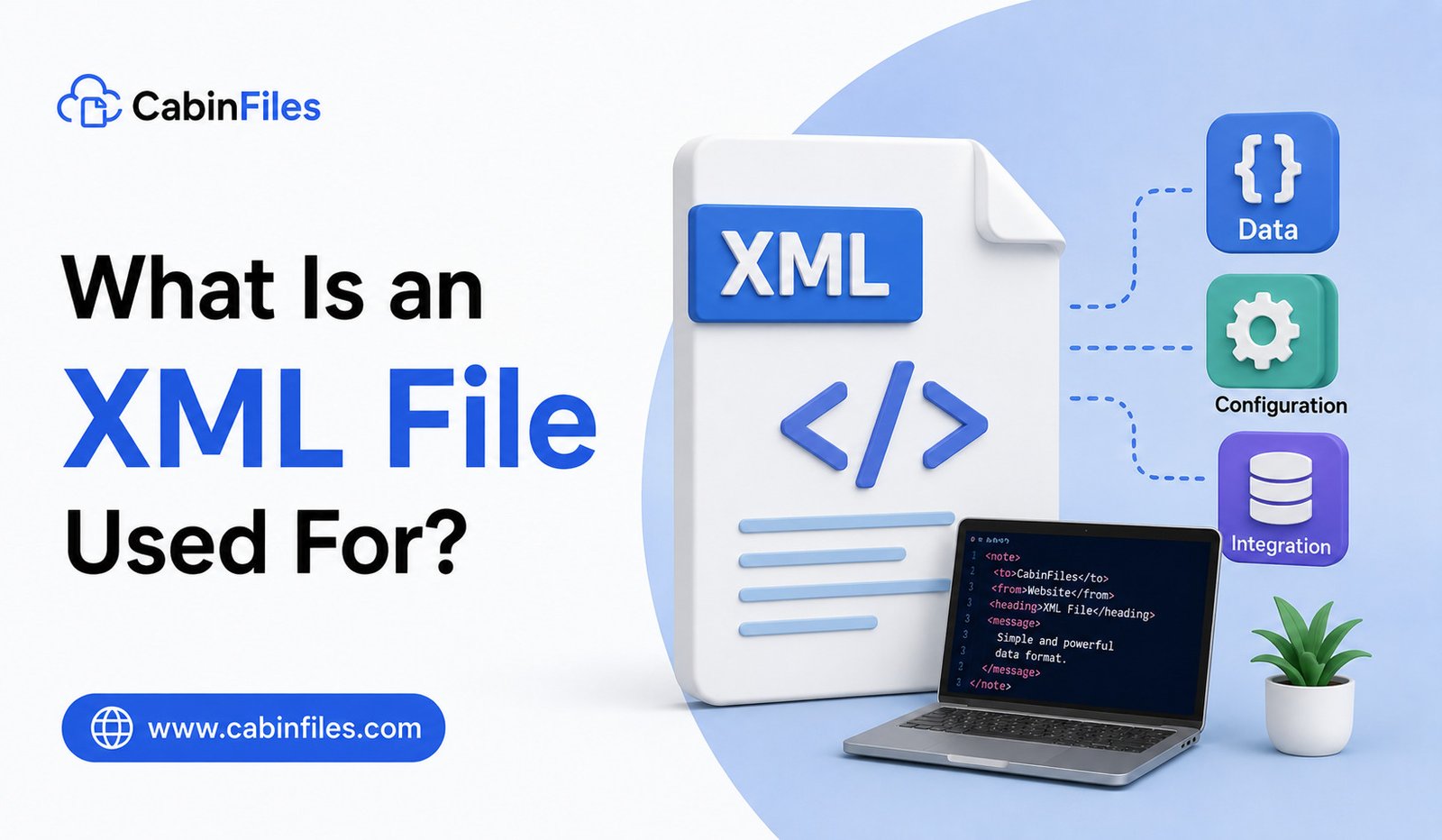
If you have ever downloaded a configuration file, opened a website’s data feed, or worked with software settings, you may have encountered a file ending in .xml. XML files are widely used by websites, applications, businesses, and developers to store and exchange structured information.
Unlike formats designed primarily for human reading, XML is structured so that both people and computer programs can understand the relationships between different pieces of data.
But what is an XML file used for, and how does it actually work? In this guide, we will explain XML in simple terms, explore its common uses, and show how you can open and edit XML files safely.
What Is an XML File?
XML stands for Extensible Markup Language. An XML file is a text-based file that stores structured information using tags.
A simple XML file might look like this:
<?xml version=”1.0″ encoding=”UTF-8″?>
<product>
<name>Wireless Keyboard</name>
<price>1500</price>
<stock>25</stock>
</product>
Unlike HTML, XML does not come with a fixed set of tags for displaying content. Developers can create tags that describe the information being stored.
In this example, tags such as <name>, <price>, and <stock> describe what each value represents.
This makes XML useful for storing and transferring structured data.
How Does XML Work?
XML organizes information using a hierarchy.
A document can contain a main element, often called the root element, with other elements nested inside it.
For example:
<customer>
<name>Priya</name>
<email>[email protected]</email>
<address>
<city>Pune</city>
<country>India</country>
</address>
</customer>
Here, the <customer> element contains several pieces of information. The <address> element contains additional child elements.
This hierarchical structure allows software to understand relationships between different pieces of data.
What Is XML Used For?
XML has many uses, particularly when different systems need to store or exchange structured information.
Common applications include:
- Software configuration
- Data exchange
- Website feeds
- Document storage
- Application settings
- Business data
- Web services
- Database exports
- Office documents
- System integration
Although newer technologies are often preferred for certain applications, XML remains widely used because of its flexibility and long history.
1. Storing Configuration Settings
One common use of XML is storing application configuration information.
A program might use an XML file to store settings such as:
<settings>
<theme>dark</theme>
<language>English</language>
<autosave>true</autosave>
</settings>
When the application starts, it can read these values and configure itself accordingly.
Many software systems use configuration files to separate settings from the main application code.
You should not edit an application’s XML configuration file unless you understand what the settings control. Changing the wrong value can cause the software to malfunction.
2. Exchanging Data Between Applications
XML is useful when two different applications need to exchange structured information.
For example, one business system might generate customer information in XML, while another system reads the file and imports the records.
Because XML describes the meaning of data through tags, different systems can interpret the information without needing to rely on the same internal database structure.
This makes XML useful for integrations between different software platforms.
3. Websites and RSS Feeds
XML has historically played an important role in web technologies.
RSS feeds, which allow websites to publish updates that can be read by feed readers and other applications, commonly use XML-based structures.
An RSS document might contain information about an article such as its title, link, publication date, and description.
Although users may not directly see the XML when reading a website, applications can process it in the background.
4. Website Sitemaps
XML is also commonly associated with XML sitemaps.
A sitemap can provide search engines with information about URLs on a website.
A basic sitemap structure can look like:
<urlset>
<url>
<loc>https://example.com/page</loc>
</url>
</urlset>
Website owners can use XML sitemaps to help search engines discover pages and understand certain information about a site’s URL structure.
5. Software and System Integration
Businesses often use XML when connecting different systems.
For example, an organization might have separate systems for orders, inventory, accounting, and customer management.
XML can provide a structured format for moving information between these systems.
Although APIs using JSON are extremely common today, XML remains important in many enterprise environments and older integrations.
6. Storing Structured Documents
XML is not limited to small pieces of data.
It can also represent complex documents containing headings, paragraphs, tables, metadata, and other structures.
Some document formats use XML internally.
For example, modern Office document formats such as .docx and .xlsx are based on collections of XML files packaged inside ZIP containers.
This means that although you normally open a Word or Excel document using an Office application, XML is part of the underlying structure.
7. Data Import and Export
Many applications provide XML as an option for importing or exporting data.
This can be useful when moving information between different programs or creating backups of structured records.
For example, an application might allow users to export settings or records to an XML file and later import them into another installation.
Whether XML is available depends on the particular software.
XML vs HTML: What’s the Difference?
XML and HTML both use tags, but they have different primary purposes.
HTML is mainly designed to structure and display content on web pages.
XML is designed to describe and store structured information.
For example, HTML might use a heading tag to define how text appears on a page, while XML could use a custom <product> or <customer> tag to describe what a piece of data represents.
XML does not automatically determine how information should look on a screen.
XML vs JSON: Which Is Better?
XML and JSON are both used for structured data exchange.
JSON is often more compact and is widely used in modern web APIs. It is also straightforward to work with in many programming languages.
XML can be more verbose, but it offers a rich structure and supports features such as attributes, namespaces, and schemas.
Neither format is universally better.
For modern web applications, JSON is often a popular choice. XML remains valuable in enterprise software, document formats, legacy systems, configuration files, and established data-exchange systems.
How Can You Open an XML File?
Because XML is text-based, you can open it with many applications.
On Windows, you can use Notepad or another text editor to view the raw XML.
Web browsers can also display XML in a readable tree-like or text format, depending on the browser.
For editing larger XML files, developers often use specialized XML editors or code editors that provide syntax highlighting and validation.
If the XML belongs to a particular application, it is usually best to let that application manage the file rather than manually editing it.
Can You Edit an XML File?
Yes, XML files can be edited with a text editor or XML editor.
However, XML has rules that must be followed.
For example, elements generally need properly matched opening and closing tags:
<name>Rahul</name>
Changing:
<name>Rahul</email>
would make the structure invalid because the opening and closing tags do not match.
A missing quotation mark, incorrect nesting, or invalid character can also cause software to reject the file.
For important configuration or data files, create a backup before editing.
Are XML Files Safe?
XML is simply a data format, so the .xml extension alone does not tell you whether a file is safe.
XML files can contain ordinary data, configuration information, or content that an application processes in potentially sensitive ways.
Be cautious with XML files received from unknown sources, particularly if a program will automatically process them.
For business or development environments, XML processing should follow appropriate security practices.
Final Thoughts
An XML file is used to store, organize, and exchange structured information. Its flexible tag-based structure makes it useful for application configuration, data transfers, website feeds, sitemaps, business integrations, document formats, and many other purposes.
XML may look complicated when you first open it, but its basic concept is simple: tags describe what different pieces of information represent and how they relate to one another.
While JSON has become increasingly popular for modern web applications, XML remains an important technology, especially in enterprise software, established systems, configuration files, and structured document formats. Understanding XML can therefore help you work with a wide range of software and data files.