
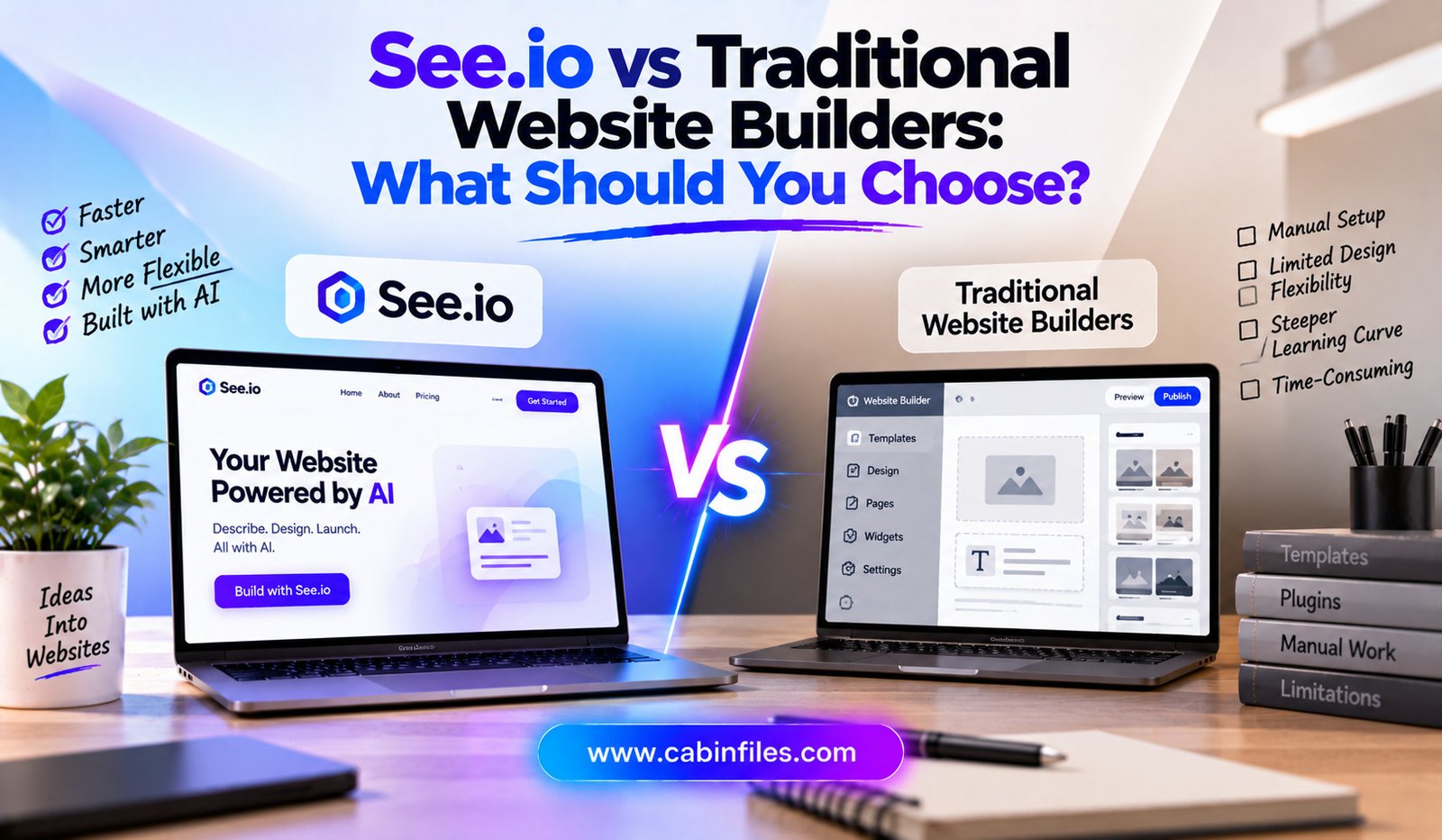
Building a website is easier than ever, but choosing the right way to build it can still be confusing. You can use a traditional website builder, choose a template and customize it manually, or use an AI-powered platform such as See.io to generate a website from a simple description.
The right choice depends on what you are building, how quickly you want to launch, how much control you need, and how comfortable you are with technology.
See.io takes a different approach from conventional website builders. Its website explains that users can describe an idea, have an AI agent design and build the site, and put it online within minutes. It also generates and edits actual website code rather than relying only on a template-selection workflow.
So, See.io vs traditional website builders: which one should you choose? Let’s compare both approaches and find out where each option makes the most sense.
What Is See.io?
See.io is an AI-powered website-building platform designed around a conversational approach. Instead of beginning with a template and manually arranging individual sections, you describe what you want the website to look like and what it should contain.
The AI agent then works on the design and code and deploys the result online. Users can continue making changes by describing what they want to change.
For example, you could ask for a professional website for a local service business and then request changes such as making the header darker, adding a contact form, or changing particular sections.
According to See.io, every edit is deployed to the live site, while previous versions are saved so users can restore an earlier version if necessary.
This makes See.io particularly interesting for people who want to build websites without learning traditional web development.
What Are Traditional Website Builders?
Traditional website builders generally work through templates, visual editors, drag-and-drop tools, and predefined components.
Popular website-building platforms have made it possible for beginners to create websites without writing code. You select a template, replace the sample content, customize colors and fonts, add pages, and publish the site.
This approach gives users a visual representation of their website while they build it.
Traditional builders can be especially useful for websites that need ongoing content management, ecommerce features, blogging, marketing integrations, or established website-management tools.
Modern traditional builders are also adding AI capabilities, so the difference between AI-first and conventional platforms is becoming less clear. Current website-builder comparisons show that established platforms increasingly combine AI generation with visual editing and other mature website features.
See.io vs Traditional Website Builders: The Biggest Difference
The main difference is how you start building.
With a traditional builder, you usually start by selecting a template or creating a page and then making changes yourself.
With See.io, you can begin with an idea.
You might describe your business, target audience, preferred style, services, and desired sections. The AI then creates the initial website based on your instructions.
This can significantly reduce the blank-page problem that beginners often experience.
Instead of asking, “Which template should I choose?”, you can focus on explaining what you want your website to accomplish.
Speed of Website Creation
Speed is one of See.io’s strongest potential advantages.
Traditional website builders can be relatively easy to use, but you still need to make many decisions manually. Choosing layouts, changing sections, writing content, adjusting images, and organizing pages can take considerable time.
See.io is designed to shorten that initial process. Its platform says a website can be designed, built, and deployed in minutes after describing the idea.
This makes an AI-first approach appealing when you need a landing page, small business website, campaign page, portfolio, or basic online presence quickly.
However, speed should not be confused with completeness. A website that takes minutes to generate may still require human editing before it is ready for serious business use.
Design and Customization
Traditional website builders usually provide a visual interface where you can directly modify design elements.
This is useful if you already know what you want and prefer making changes yourself.
See.io takes a more conversational approach. Rather than manually adjusting every element, you can describe a desired change and allow the AI to implement it.
This can make experimentation easier. You could ask the system to create a cleaner homepage, change the navigation style, add a new section, or adjust the visual presentation.
The trade-off is that AI-generated results may not always match your expectations on the first attempt. You may need to refine your instructions several times.
Ease of Use for Beginners
For someone with little or no coding experience, See.io can be attractive because the building process is based on plain-language instructions.
You do not necessarily need to understand HTML, CSS, JavaScript, or other development technologies to get started.
Traditional website builders are also beginner-friendly, but they generally require users to learn how their editor works.
For people who enjoy visual editing and want direct control, that may actually be an advantage.
For users who would rather explain an idea and let AI handle the technical implementation, See.io may provide a simpler experience.
SEO Considerations
SEO should be considered regardless of which website-building method you choose.
An AI-generated website is not automatically guaranteed to rank well in search engines. You still need useful content, appropriate keyword targeting, descriptive titles, logical headings, good internal linking, mobile usability, and a strong user experience.
Traditional website platforms often provide established SEO settings and tools, although the exact capabilities vary between platforms.
With See.io, the important question is not simply whether AI can create the website but whether you can effectively control and optimize the technical and content elements that matter for your SEO strategy.
For a website intended to attract search traffic over several years, investigate available SEO controls before committing to any platform.
Content Creation
AI can provide a major advantage when you are starting without website copy.
Instead of writing every section manually, you can describe your business and let AI help create an initial version.
But AI-generated content should always be reviewed.
Your website needs specific information that reflects your real business. Generic phrases can make a website sound similar to hundreds of others.
Traditional builders do not automatically solve this problem either. You still need to provide good content, whether you write it yourself or use a separate AI writing tool.
The best approach is to use AI for speed while adding your own expertise, examples, facts, and brand voice.
Maintenance and Future Changes
A website is not finished when it goes live.
You may need to change prices, update services, add blog posts, replace images, modify contact information, or create new landing pages.
See.io’s conversational editing model can make certain changes straightforward because you can describe what you want rather than manually rebuilding the page. The platform also states that versions are saved automatically and can be restored.
Traditional builders, meanwhile, usually give you direct access to the visual editor and website settings.
For teams that regularly make detailed manual changes, this can be more predictable.
The best choice therefore depends on whether you prefer AI-assisted editing or hands-on visual control.
Cost and Long-Term Value
Cost should not be judged only by the monthly subscription.
You should also consider the value of your time.
See.io currently states that users can start building without a card and that keeping a site online costs $9.99 per month, with managed HTTPS hosting included.
Traditional website builders have different pricing models, and costs can vary depending on hosting, premium templates, ecommerce tools, plugins, domains, and additional services.
Before choosing, calculate your expected total cost over at least one year.
A cheaper platform is not necessarily better if it requires significantly more time or paid add-ons to achieve what you need.
Who Should Choose See.io?
See.io may be a strong option if you:
- Want to launch a website quickly
- Have little or no coding experience
- Prefer describing changes in plain language
- Need a small business or service website
- Want to experiment with different website ideas
- Need a landing page or simple online presence
- Want AI to handle much of the initial development work
It can be particularly useful for entrepreneurs and creators who want to move from an idea to a working website without spending days learning web development.
Who Should Choose a Traditional Website Builder?
A traditional website builder may be better if you:
- Want extensive visual editing controls
- Need advanced ecommerce functionality
- Require a mature content management system
- Depend on many third-party integrations
- Have a team that regularly manages website content
- Need specialized features or workflows
- Prefer choosing and modifying templates yourself
Established website platforms can be especially useful for long-term websites where content management, integrations, marketing tools, and operational stability are major priorities.
Should You Choose See.io or a Traditional Builder?
There is no universal winner.
Choose See.io if your priority is speed, simplicity, and AI-assisted website creation. It can help turn an idea into a functioning website without requiring you to manually build every component.
Choose a traditional website builder if you want established website-management features, detailed visual control, or a broader ecosystem for a more complex project.
There is also a third option: use a platform that combines traditional website-building controls with AI. This hybrid approach is becoming increasingly common, allowing users to get AI-generated starting points while retaining conventional editing tools.
Final Verdict
The choice between See.io and traditional website builders ultimately comes down to your priorities.
If you want to go from idea to website quickly, an AI-first platform such as See.io can be an appealing choice. Its conversational workflow reduces much of the manual setup and allows users to request changes using everyday language.
Traditional website builders remain valuable when you need more established tools, structured content management, extensive integrations, or hands-on control.
Before choosing, think beyond the initial launch. Consider how you will edit the website six months from now, what features you may need as your business grows, and how much control you want over the website.
For a simple project where speed matters most, See.io is worth considering. For a larger, feature-heavy website with long-term operational requirements, a traditional platform may still be the safer choice.