
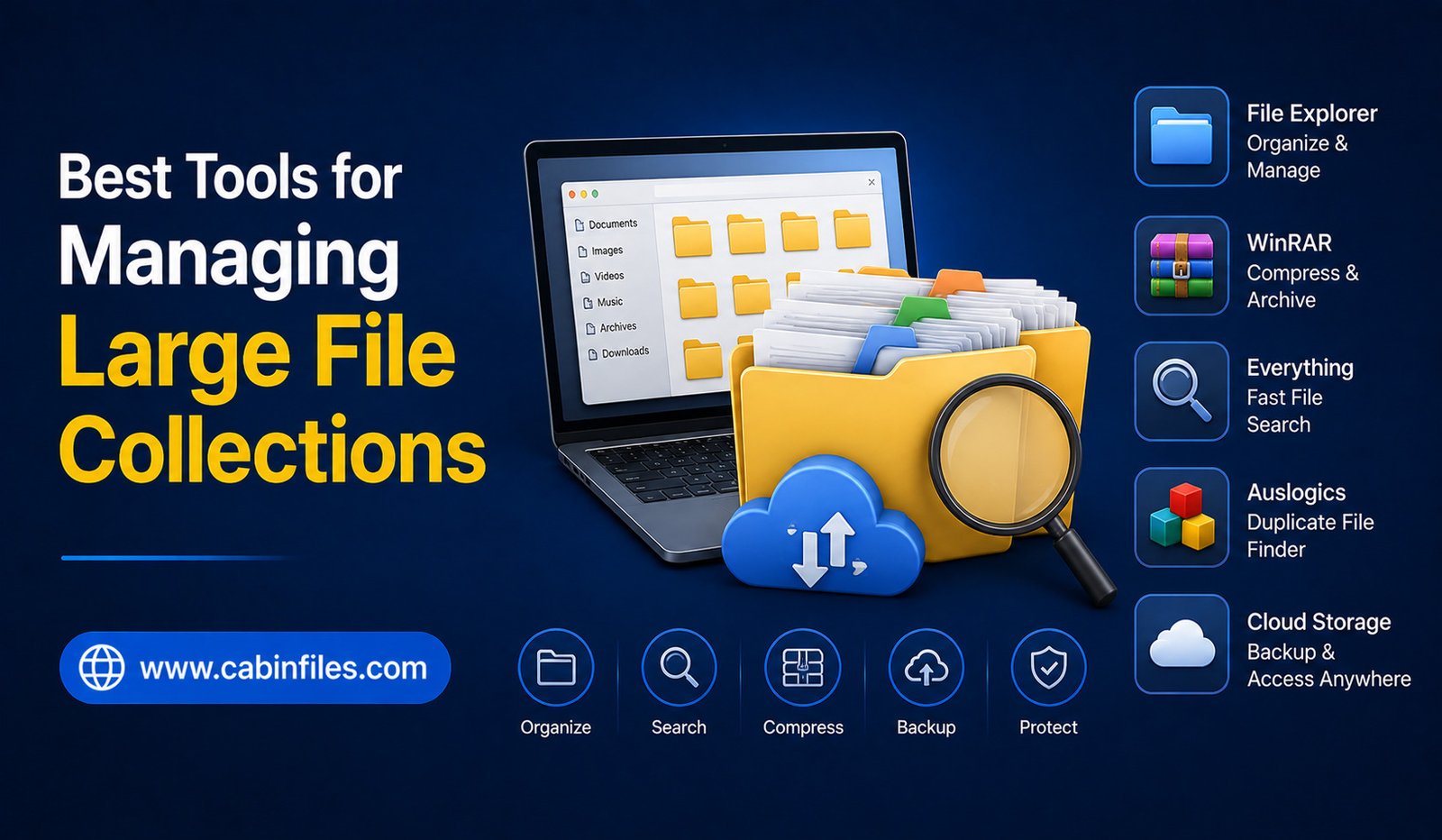
Managing a large collection of files can become difficult surprisingly quickly. A computer may contain thousands of documents, photographs, videos, software installers, ZIP archives, downloads, and project folders. As the collection grows, finding specific files, identifying unnecessary data, and keeping everything organized can take more time than expected.
The good news is that you do not need to manage everything manually. Modern file management tools can help you search for files, analyze storage usage, identify duplicates, organize folders, rename files in batches, and create safer backup workflows.
The best tool depends on what you need. Some applications focus on fast searching, while others are designed to visualize disk usage or provide advanced file-management features. Here are some of the most useful options for managing large file collections.
Why Large File Collections Become Difficult to Manage
Large collections usually become disorganized gradually. A few downloaded files turn into hundreds of downloads, old project folders remain untouched, and duplicate photographs accumulate across multiple locations.
Another problem is storage visibility. Windows File Explorer can show individual files, but it is not always easy to understand which folders are consuming the most space.
Large collections also make searching more important. When you have thousands or millions of files, manually browsing folders is inefficient.
This is where specialized file-management tools can make a noticeable difference.
1. Windows File Explorer
Before installing third-party software, it is worth using the file manager already included with Windows.
File Explorer provides folder navigation, file searching, sorting, filtering, file previews, and access to local and connected cloud storage. Windows Search can also search files and apps from the taskbar or File Explorer.
For many users, File Explorer is enough for basic organization.
You can create a folder structure based on projects, file types, years, or other categories. Sorting files by name, date, size, or type can also make large folders easier to understand.
The main limitation appears when your collection becomes extremely large or when you need specialized functions such as duplicate detection, visual storage analysis, or advanced batch operations.
2. Everything
When the biggest problem is finding files quickly, Everything is one of the tools worth considering.
Everything is a Windows file-search application designed to find files and folders by name. Its project describes quick indexing, real-time updating, and very fast search results, including environments containing very large numbers of files.
Instead of opening multiple folders and searching manually, you can type part of a filename and quickly narrow down the results.
This is particularly useful for large collections containing software installers, documents, images, archives, and project files with inconsistent locations.
Everything is best viewed as a specialized search tool rather than a complete replacement for File Explorer. It helps you locate files quickly, after which you can manage them using normal file operations.
3. WinDirStat
If your main problem is running out of storage space, WinDirStat can be particularly useful.
WinDirStat is an open-source disk-usage analyzer for Windows. It scans selected drives or folders and presents storage information through a directory tree, file-type statistics, and an interactive treemap.
The treemap is especially useful because large files appear as larger blocks. This gives you a visual way to identify what is consuming your storage.
WinDirStat can also help identify large files, search and filter results, and detect duplicates.
For example, if your hard drive is nearly full, a scan may reveal that an old video folder, software archive, or backup directory is taking up far more space than expected.
The important thing is to review files carefully before deleting anything. A large file is not necessarily an unnecessary file.
4. Dedicated File Managers
Power users who regularly move, copy, rename, or compare large numbers of files may benefit from a dedicated third-party file manager.
These applications can offer features such as dual-pane browsing, advanced search, batch renaming, folder comparison, synchronization, and improved file-operation workflows.
A dual-pane interface is particularly useful for large collections because you can view two locations at the same time. This makes it easier to move files between drives or compare folder structures.
Dedicated file managers are most useful when standard File Explorer feels too limited for repetitive file-management tasks.
5. Cloud Storage Services
Cloud storage can also become an important part of managing large collections.
Services such as OneDrive, Google Drive, and Dropbox allow files to be stored and synchronized across devices. They can be particularly useful for documents and projects that need to remain accessible from multiple computers.
However, cloud storage should not automatically be considered a complete backup solution.
Synchronization can sometimes replicate deletions or unwanted changes. For important files, maintain a proper backup strategy in addition to cloud synchronization.
Cloud storage is best used as part of a broader file-management system rather than as the only place where important data exists.
6. Duplicate File Finders
Duplicate files can consume a surprising amount of storage.
You might have the same photograph saved in several folders, multiple copies of an installer, or duplicate documents created during different versions of a project.
Duplicate-file tools compare files and identify potential copies so you can review them before removing unnecessary versions.
Some tools compare filenames, while more advanced utilities can compare file contents or hashes.
Be careful when deleting duplicates. Two files with identical names are not necessarily identical, and two files with identical contents may still have different purposes or locations.
Always review the results before permanent deletion.
7. Batch Renaming Tools
Large collections often become difficult to manage because filenames are inconsistent.
Imagine having hundreds of photographs named with camera-generated numbers or a collection of documents using unrelated naming styles. Finding the right file becomes harder when filenames provide little useful information.
Batch-renaming tools allow you to rename many files according to a consistent pattern.
For example, photographs could be renamed using a project name and date, while documents could receive a consistent naming structure.
A good naming system can reduce your dependence on complicated folder structures and make future searches much easier.
8. Archive and Compression Tools
Archive utilities are useful when your large file collection contains many files that do not need to be accessed individually every day.
ZIP, RAR, and 7Z archives can package multiple files and folders into a single container. Compression may also reduce storage requirements for data that compresses efficiently.
Archives can be useful for completed projects, old documents, software collections, and files that need to be transferred as a single package.
However, do not treat compression as a guaranteed way to dramatically reduce file size. Already-compressed photographs, videos, and many software packages may shrink very little.
9. Backup Software
Organization is only one part of managing a large collection. Protecting the files is equally important.
Backup software can automatically copy important files to another drive, server, or storage location according to a schedule.
This becomes increasingly important as your collection grows. Losing a few unimportant downloads may be inconvenient, but losing years of photographs or an entire business project can be much more serious.
A practical backup strategy should include more than one copy of important data and, ideally, protection against hardware failure, accidental deletion, and other problems.
How to Choose the Right File Management Tool
The best tool depends on your biggest problem.
If you simply need to browse folders and perform ordinary file operations, File Explorer may be sufficient.
If you frequently struggle to find files, Everything can provide much faster filename searching.
If your hard drive is full and you need to understand where the storage is going, WinDirStat is a useful option.
If you regularly perform advanced file operations, a dedicated file manager may be more appropriate.
For duplicate-heavy collections, consider a reputable duplicate-file finder. For long-term storage, combine organization tools with a reliable backup system.
Create an Organization System Before Installing More Tools
Software can help, but no application can completely replace a sensible organization system.
Start by deciding how your files should be grouped. You might organize them by project, year, client, file type, or purpose.
Use meaningful filenames rather than relying entirely on random numbers. Avoid creating excessively deep folder structures, but also avoid putting thousands of unrelated files into a single directory.
It is also useful to periodically review your Downloads folder and temporary directories.
A simple organization system maintained consistently can be more effective than installing several specialized applications and using none of them regularly.
Be Careful When Deleting Large Files
One of the biggest risks of storage-management software is deleting something simply because it looks unnecessary.
Before deleting a large file, check what it is, where it came from, whether another application depends on it, and whether you have a backup.
Be especially careful with system folders, application directories, recovery files, and unfamiliar files.
Storage analysis tools are designed to help you identify potential cleanup targets, but the final decision should be made carefully.
Final Thoughts
Managing a large file collection becomes much easier when you combine the right tools with a consistent organization strategy.
Windows File Explorer remains a good starting point for everyday file management, while Everything is useful when fast searching is the priority. WinDirStat is particularly helpful for understanding which files and folders are consuming storage, thanks to its detailed disk-usage views and treemap.
For more advanced workflows, dedicated file managers, duplicate-file utilities, archive tools, and backup software can provide additional capabilities.
The most effective approach is not simply to install as many tools as possible. Instead, identify the problem you face finding files, freeing storage, removing duplicates, organizing folders, or protecting data and choose a tool designed specifically for that task. With a clear folder structure, sensible filenames, regular cleanup, and reliable backups, even a collection containing thousands of files can remain manageable.