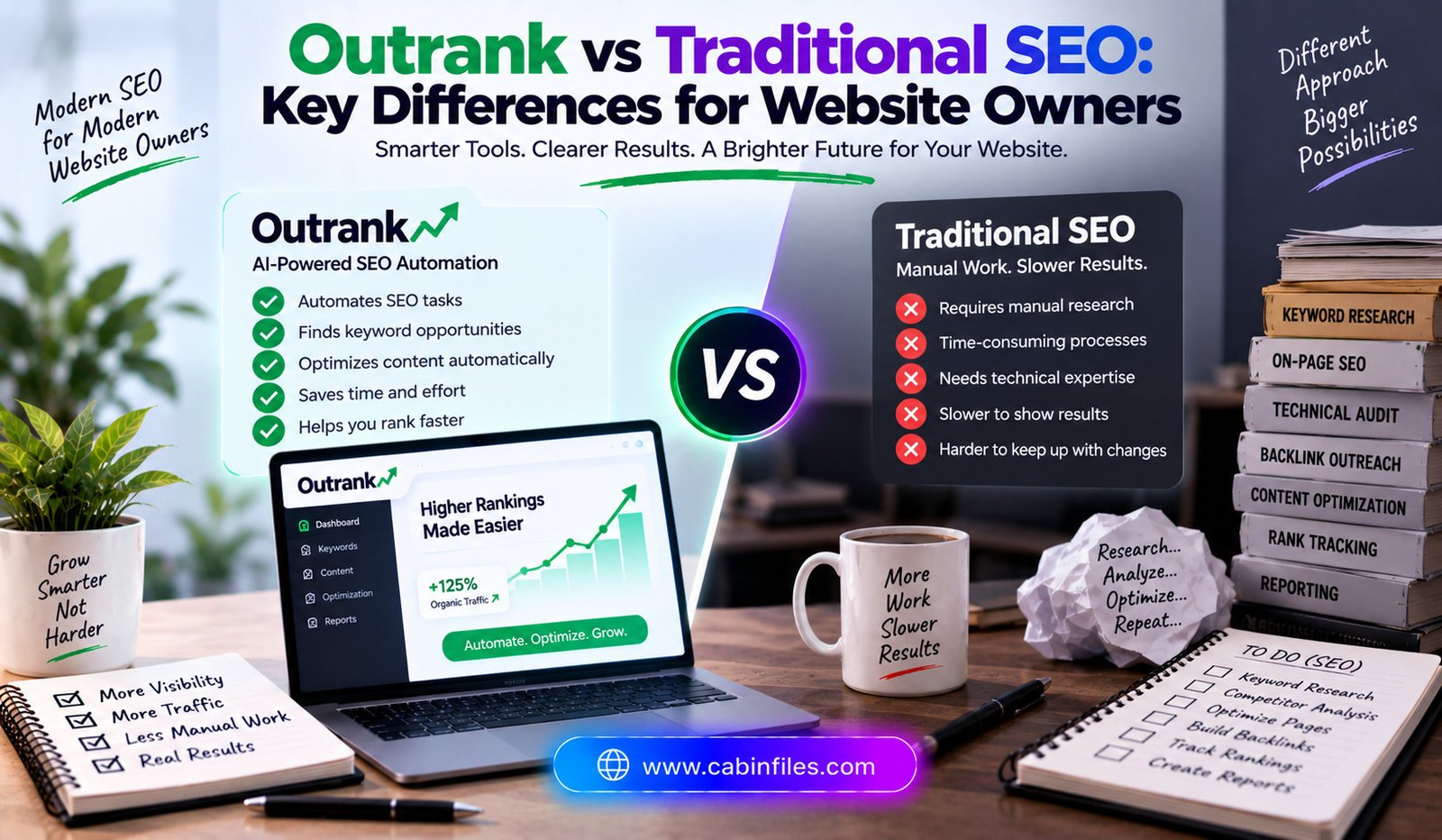
Search engine optimization remains one of the most important ways for a website to attract visitors without paying for every click. However, the way SEO is performed is changing. Traditional SEO has depended heavily on manual keyword research, content writing, competitor analysis, link building, technical optimization, and performance tracking. Today, AI-powered platforms such as Outrank are attempting to automate many of these activities.
For website owners, this creates an important question: Should you continue with traditional SEO, or can an AI-powered platform like Outrank make the process faster and easier?
The answer depends on the type of website, available resources, business goals, and how much control you want over your SEO workflow. Understanding the differences between Outrank and traditional SEO can help you choose a practical approach.
What Is Traditional SEO?
Traditional SEO is a structured process where website owners or SEO professionals manually handle different parts of search optimization.
The process usually starts with keyword research. After identifying potential search terms, an SEO specialist studies competitors, analyzes search intent, plans content, creates optimized pages, improves internal linking, works on backlinks, and monitors search performance.
Technical SEO is another important component. Website speed, mobile usability, indexing, structured data, broken links, redirects, and other technical elements may need regular attention.
Traditional SEO gives businesses a high level of control because people make the decisions at every stage. However, that control comes with a significant investment of time and resources.
How Outrank Changes the SEO Workflow
Outrank takes a more automated approach. Its platform is built to combine several SEO and content activities into a single workflow.
According to Outrank, its system can help with keyword research, SEO content generation, internal and external linking, AI-generated images, and publishing to supported content management systems. It also provides integrations with platforms such as WordPress, Webflow, Shopify, Wix, Framer, Notion, and Ghost. (outrank.so)
Instead of managing every individual step manually, website owners can use automation to speed up content-focused SEO activities.
This does not mean that traditional SEO disappears. Rather, automation changes how much manual effort is required.
Keyword Research: Manual Discovery vs AI Assistance
Keyword research is one of the foundations of SEO.
With traditional SEO, finding useful keywords can involve several different tools and considerable manual analysis. Website owners need to examine search intent, competition, relevance, potential traffic, and how closely a keyword connects with their business.
Outrank is designed to automate parts of this discovery process. Its platform promotes automated keyword research intended to identify opportunities based on a website’s niche and SEO objectives. (outrank.so)
The main benefit is efficiency. AI can help website owners discover potential topics faster.
However, keyword selection should not be completely automated. A keyword may appear attractive from an SEO perspective but have little value for the actual business. Human judgment remains important when deciding which opportunities deserve investment.
Content Creation: Human Writers vs AI Generation
Content production is another area where the difference becomes obvious.
Traditional SEO generally relies on writers, editors, subject experts, or business owners to create articles. This approach can produce highly specific content, but publishing consistently can become expensive and time-consuming.
Outrank is designed to generate SEO-focused content from selected topics and keywords. The platform can incorporate elements such as headings, links, and images into the content workflow. (outrank.so)
This can be useful for websites that need to publish regularly.
However, AI-generated content still needs quality control. Website owners should review articles for factual accuracy, originality, usefulness, brand voice, and search intent.
The goal should not be to publish as many pages as possible. The goal should be to create pages that genuinely help visitors.
Internal Linking Becomes Easier With Automation
Internal linking helps visitors discover related pages while also giving search engines additional information about the structure and relationships within a website.
Traditionally, internal links are added manually during content creation or through periodic website audits. On a small website, this is manageable. On a large website with hundreds or thousands of pages, it can become difficult.
Outrank incorporates internal linking into its automated content workflow. This can reduce the amount of manual work involved in connecting related content. (outrank.so)
Even with automation, website owners should review important links to make sure they are contextually useful rather than simply inserted for SEO purposes.
Publishing: Manual Management vs Automated Workflows
Creating content is only one part of running an SEO strategy. Once an article is ready, it needs to be uploaded, formatted, scheduled, and published.
Traditional workflows often require someone to complete these tasks manually.
Outrank offers publishing integrations that can connect the platform with several website platforms. Its system is designed to allow content to move from the SEO workflow to publication with less manual intervention. (outrank.so)
For businesses that publish frequently, this can be a major time saver.
It also makes maintaining a regular publishing schedule easier because website owners do not have to manually upload every article.
Backlinks: Traditional Outreach vs Automated Opportunities
Backlinks remain an important consideration in SEO. Traditionally, link building can involve finding relevant websites, contacting publishers, creating outreach campaigns, negotiating placements, and tracking results.
This process can require considerable effort.
Outrank offers a backlink exchange feature intended to help participating websites obtain relevant backlink opportunities through its network. The platform describes relevance monitoring as part of the process. (outrank.so)
This differs from conventional outreach because some of the discovery and relationship-building work is handled through a platform.
However, website owners should always evaluate backlinks based on quality and relevance. A large number of low-value links is not necessarily better than a smaller number of genuinely useful references.
Scalability Is a Major Difference
Traditional SEO can become difficult to scale because increasing content production often means increasing the number of people involved.
A company managing one website might work with a writer and SEO specialist. An agency managing dozens of websites may need a much larger team.
AI automation can reduce some of this pressure.
Outrank’s current product information includes automated keyword research, AI content creation, publishing integrations, images, and backlink-related functionality. Its pricing information also describes plans designed around producing multiple SEO articles each month. (outrank.so)
This makes automation particularly attractive for agencies, publishers, startups, and businesses that want to increase their content output without expanding their team at the same rate.
Human Control Remains a Traditional SEO Advantage
Traditional SEO has an important advantage: human professionals can make highly specific decisions.
An experienced SEO specialist can understand a company’s customers, identify unusual search opportunities, recognize industry trends, evaluate competitors, and adjust a strategy based on business priorities.
AI tools can support these activities, but they do not automatically understand every aspect of a company’s situation.
For this reason, businesses with complicated SEO requirements may benefit from keeping humans involved in strategy even when AI handles repetitive execution.
Which Approach Costs More?
The cost comparison between traditional SEO and Outrank is not simply about software versus people.
Traditional SEO costs can include salaries, freelance writers, SEO tools, agency fees, technical specialists, editors, and outreach resources.
An automated platform introduces a software subscription instead. Outrank’s current pricing page provides its available plans and features, which can be compared with the cost of maintaining a fully manual workflow. (outrank.so)
For a small business, automation may reduce operational costs. For a larger organization, the biggest benefit may instead be increased productivity.
The right choice depends on how much SEO work your website needs and how much internal expertise is available.
Is Outrank Better Than Traditional SEO?
There is no single answer.
Outrank can be attractive for website owners who want to automate repetitive content-related SEO tasks and publish consistently. It can help streamline keyword discovery, content creation, internal linking, image generation, and publishing.
Traditional SEO remains valuable when a website requires highly customized strategy, extensive technical work, detailed industry expertise, or hands-on editorial control.
For many website owners, a combination of both approaches may make the most sense.
AI can handle repetitive processes while humans concentrate on strategy, expertise, quality assurance, technical decisions, and business objectives.
Final Thoughts
The comparison between Outrank vs traditional SEO is really a comparison between manual execution and automation.
Traditional SEO provides detailed control and allows professionals to make customized decisions at every stage. Outrank aims to make SEO content production more efficient by bringing keyword research, AI writing, linking, images, and publishing into a more automated workflow. (outrank.so)
For website owners, the best approach is not necessarily to replace traditional SEO completely. Instead, AI can be used to reduce repetitive work while experienced people remain responsible for strategy and quality.
SEO success ultimately depends on more than how quickly content is produced. Relevance, usefulness, technical health, user experience, authority, and consistency all matter.
Outrank can help simplify the execution side of SEO, while traditional SEO principles can continue to guide the overall strategy. Combining both can give website owners a more efficient way to build and maintain their organic search presence.